Forests in the not-too distant-past once provided primary sustenance for people, not just the other mammals and the birds. Today, agriculture and urbanization have made that relationship more challenging. The felling of many trees has reduced both the size and species composition of the woods. Forests are increasingly unhealthy, and lack many of the sustenance-providing species they once held. Among the foods we do eat regularly, it is a crop’s harvestability and transportability that have become valued over many other traits. Foods are increasingly single-sourced, and bear little resemblance-including nutritional value-to the myriad of plants on which we once depended.
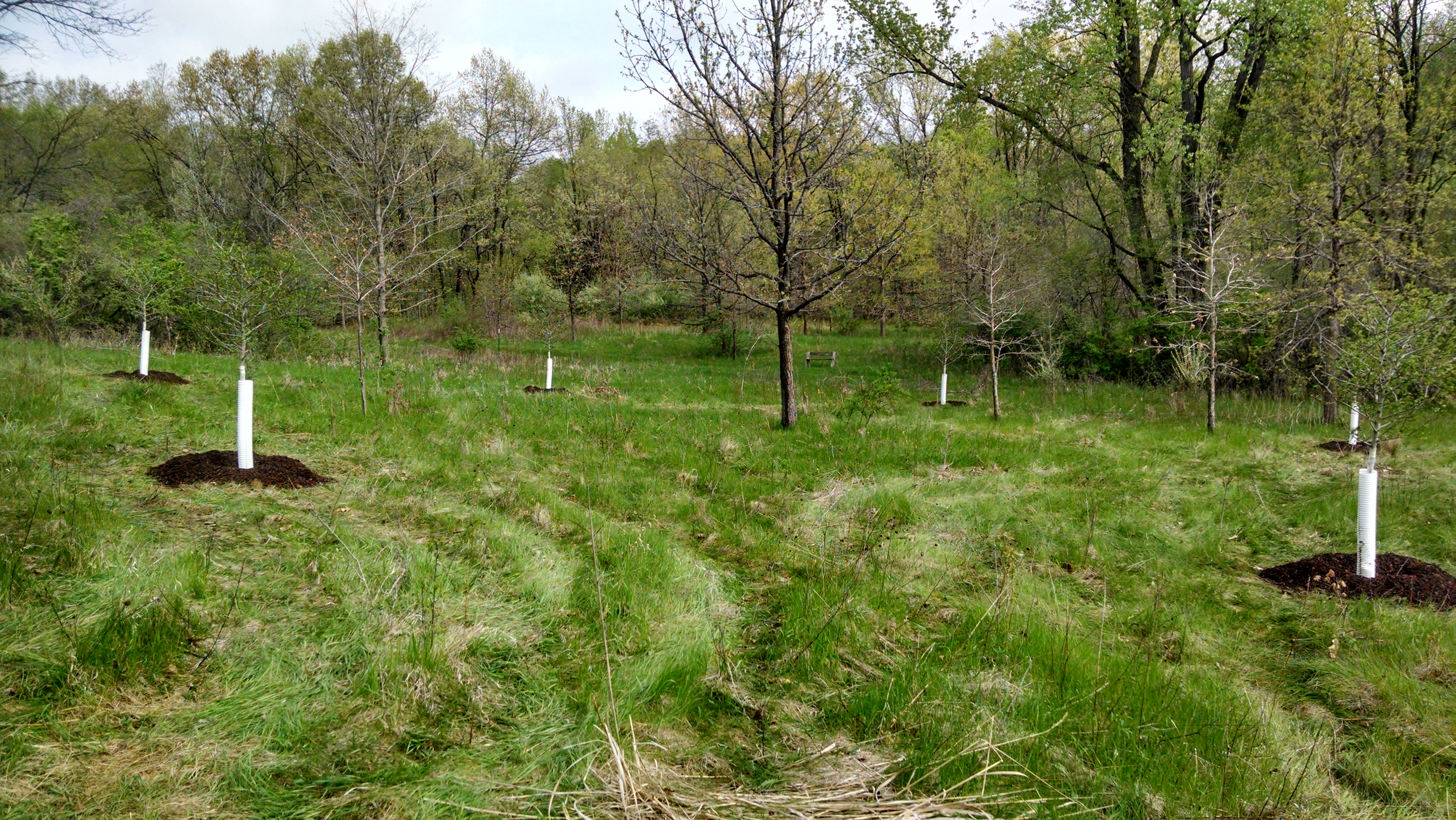
This spring, we planted six cockspur hawthorn¹ (Crataegus crus-galli) trees at Indian Creek Nature Center, as part of a woodland restoration project. For restoration purposes, the hawthorns are native trees that only grow about 25 feet tall, easy to overlook when we discuss the grandeur of the mighty oaks and hickories. Yet they provide a lot of ecological benefits, with their thicket-like tendencies that protect young nestlings, blossoms for pollinators, and edible berries for wildlife.
For human guests, the hawthorns² are the latest addition to the native edible forest at the Nature Center. Both the blossoms and berries are good to eat. The trees were planted in a wide circle, forming a grove around one of the maturing oaks. In the not-too-distant future, guests will be able to come, spread a picnic blanket in the semiprivate shade of the grove, listen to the birds all around them, and harvest a handful of berries³ for tea later that evening.
A few notes:
1. The hawthorns serve as a host plant for Cedar Apple Rust, which is hard on apple trees.
2. To find out if a species is native to your state, visit www.plants.usda.gov
3. Consuming hawthorns can help lower blood pressure. To learn more about the medicinal benefits, check out an herbal book, such as the Woman’s Book of Healing Herbs. If you’re under the care of a doctor for a blood pressure condition, talk to your doctor first.
When I think about nature, the impact it has on me, and the relationship I have with it, I tend to think about the joy of being in nature, and that all-encompassing sensory experience that we can only barely begin to understand. But I suspect, if nature were to think about me, the relationship is less positive. I drive on paved roads; I put things in the landfill that will never decompose; some of the products I use leach toxins into the water; and, I predominantly burn coal for my electricity. Now, I also work full-time to care for the environment, I am making great improvements in the products I choose, and I am conscientious about my energy use. But that doesn’t change that homo sapiens are by far the most ecologically invasive, permanently destructive species on the planet-and I am part of that problem.
The solutions are often neither obvious or easy. So I am thrilled to be part of Indian Creek Nature Center’s new construction project that is rising to meet the standards set by the International Living Future Institute’s Living Building Challenge. Not obvious and not easy (and my posts are likely to be far less frequent). But being on the leading edge of the green construction revolution will help us-all of us-live in better harmony with the environment and sustainably care for our natural resources.
The ruby-throated hummingbirds have returned. I haven’t seen one yet, but I’ve been keeping a casual eye on http://www.hummingbirds.net/map.html to track their migration north, and they have definitely been spotted in this area over the past few days.
That means it’s time to put up the hummingbird feeder. The hummingbirds will stick around for the summer and find plenty to feed on without our help. Putting out the feeder gives us an opportunity to watch their aerial acrobatics up close on a regular basis. They have distinct personalities, and don’t hesitate to find us in the yard and complain loudly if we don’t keep sugar water in the feeder. We have columbines planted for them as well, but the flowers haven’t quite started to bloom yet.
My challenge in loving nature isn’t usually the “getting outside” part, its avoiding the poison ivy that thrives in the woods. Poison ivy is beautiful, especially in the spring and fall, but the oil causes my skin to break out in open, weeping, ever-expanding, never-healing sores, which causes me to go to the doctor for prednisone, which wreaks havoc on my immune system. Last summer, I avoided the doctor/prednisone, and I am going to do my best again this summer.
Step 1. Identify.
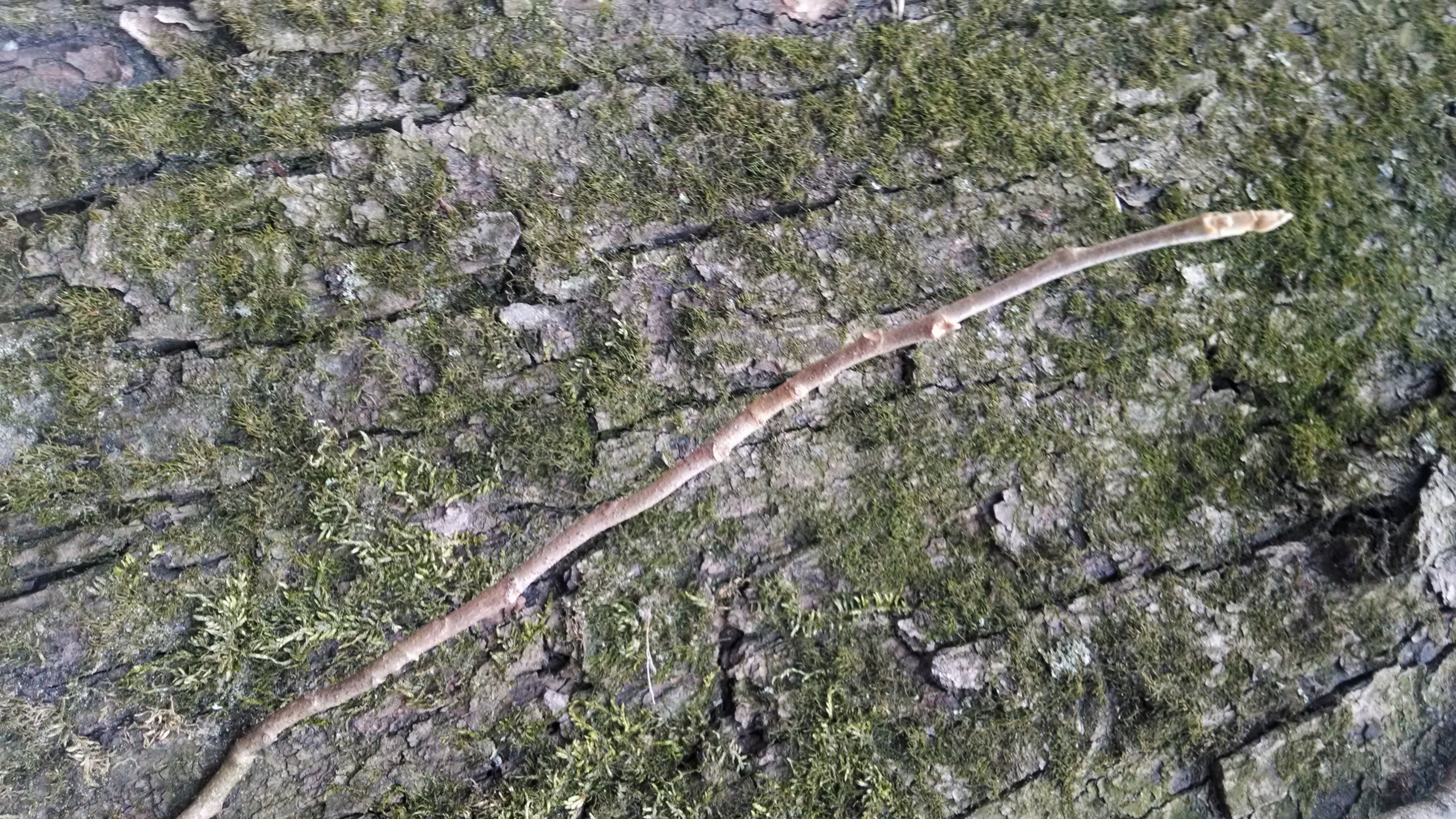
I nearly walked into this poison ivy branch, hanging face-high from a tree.The fine hairs on the main vine gave it away.
Step 2. Avoid.
The young leaves in the spring are a deep red.
Step 3. Wash thoroughly, assuming avoidance wasn’t good enough. Always a good idea after playing outside, because it provides an opportunity for a thorough tick check.
If I was in the general vicinity of poison ivy, I just use soap and water. If I’m fairly sure I actually contacted the plant, I use Goop first, which binds with the oil.
Step 4. At the first sign of breakout, start drinking copious amounts of tea made from reishi mushrooms, stinging nettle leaves, and budding goldenrod flowers. The challenge is on-we’ll see how this season goes!
The stinging nettle leaves that emerged mid-April are getting too big too harvest, but there are young plants still coming up around the edges of the nettle patches.
Happy May Day! Today, being the first day of May means we listen to “Lady Isabel and the Elf Knight” by Lisa Theriot. The song has a rich and varied historical basis which you can read all about on Wikipedia. Some day, maybe next April, I plan to research it myself!
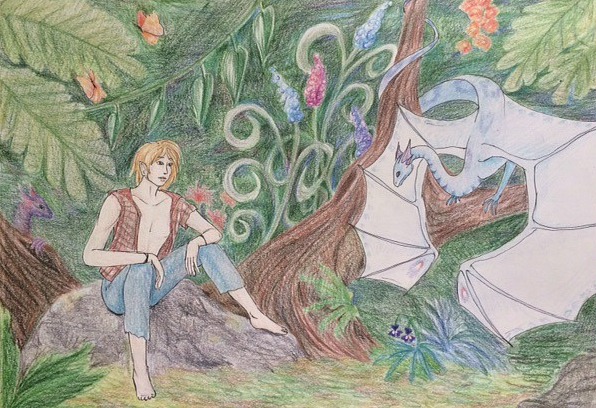
Hunting Red’s artist sketched the opening scene
My children disagree with the term “Elf Knight” — they claim he is neither elf nor knight, but rather one of the Fey. I’ll leave that research to them.
Also since it is May 1, we started our 30×30 Outdoor Challenge — with a 40 minute walk to the Hydra’s Lair. This is a retention waterway at the base of a hill in a nearby neighborhood. I have yet to see the hydra, but today there were 1000s of tadpoles wriggling in the shallows.
No hydras, just tadpoles
By checking off our 30×30 Challenge, we are also on our way to completing the 30×3 Challenge! After dinner we took a 20 minute walk as well. So 60 minutes for Day 1!
A little EARTHING in the last snow of the season
I learned a new word today. Earthing. Earthing is the process of absorbing earth’s free flowing electrons from it’s surface through the soles of one’s feet. So that’s why my children are always barefoot!
May your May be filled with music, successfully completed challenges, and a little earthing!
Or do you need a challenge to get out daily into nature?
Tomorrow is May 1. Nothing like a new month to take on a new challenge. And MAYbe this is your month. May is spring in the northern hemisphere and autumn in the southern hemisphere — not too hot, not too cold, just right for getting outside and getting a daily dose of nature time!
But…maybe you’re feeling too busy. Or maybe you’ve had a nature walk go wrong. Or maybe you can’t seem to remember a single benefit to time outdoors when the kids beg for just 30 more minutes in Minecraft. Or is that only at my house?
Getting outside, every day, can be a challenge — so here are 3 challenges to get you there:
1. Starting May 1, the David Suzuki Foundation has a 30×30 challenge. That’s 30 minutes outdoors for 30 days. Do you have 30 minutes? Just 30 out of 1440 a day — about 2% of your time.
3. Is a purposeful, structured time more your style? Back in 2008, the Handbook of Nature Study Outdoor Hour Challenge began — and is still going. Years of challenges to get you started and keep you outside!
Do you know of another challenge that encourages getting outside regularly? Share it in the comments! Or tweet to @pocketmousepub and let us know!
And after you’ve been outside, check out the Nature Chills Challenge to share what you’ve discovered!
I just read a 2010 study that found kids ages 8-18 spent 7 hours and 38 minutes in front of a screen daily, about 27% of their day. Has technology use gone up or down at your house in the last 5 years?
For National Arbor Day, I decided to plant some “mushroom trees.” I have healthy, mature oaks. I have young northern pecans, Kentucky coffeetrees, and Ohio buckeyes. I also have, typical of Iowa’s woodlands, forest areas so overgrown that trees need to be removed, not planted. And, while I continue to work on improving the diversity of the woodlands, planting a typical tree for National Arbor Day seemed counter-productive this year.
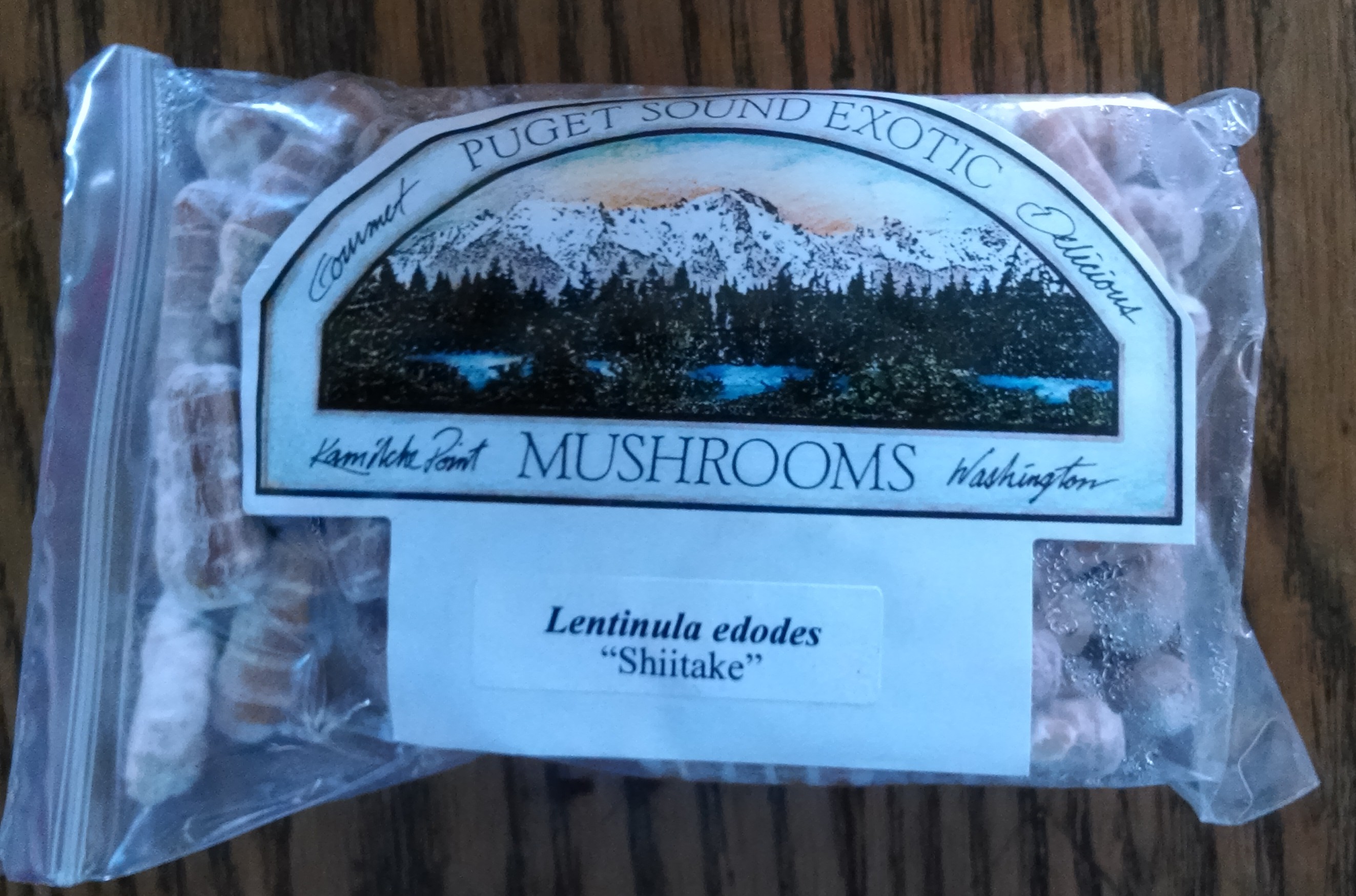
Shiitake “plug spawn”. Dowels inoculated with mycelium
Dying trees are critical for the health of a forest. They provide habitat for cavity nesting birds, screech owls, bluebirds, and wood ducks. They serve as roosts for bats and feeding stations for insect-eating birds. A dead snag hosts a tremendous variety of decomposers, from fungi to ants, which gradually break down the hard wood into soft, rich organic matter in which new life can grow.
Mycelium rapidly expanding around the dowel
I thought deliberately turning a dead log into a mushroom tree would be a fun way to celebrate the spirit of National Arbor Day, without adding a tree where it shouldn’t belong. It will celebrate that the value of a tree extends far beyond the life span of the tree. As a benefit, I will
1) expand my knowledge of mushrooms, and give me a close up, regular look at the decomposition process
2) provide me with something healthy and tasty to eat
3) provide organic material, when the tree is completely broken down.
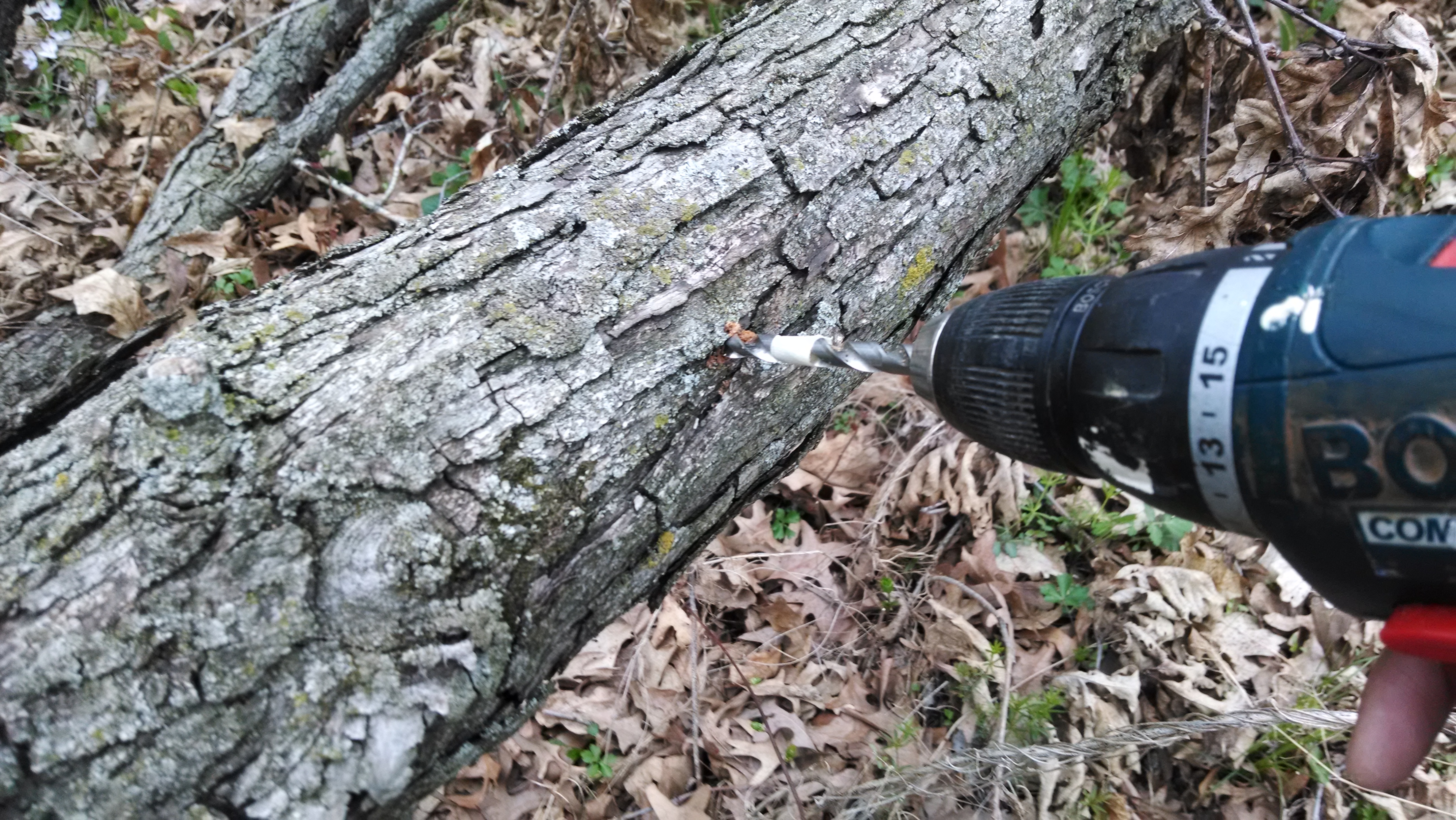
Drilling the holes in the oak limb, a casualty of a recent wind storm
In the past, I’ve grown portabella mushrooms in a box in the house, and thought this would not be too much more difficult. And then, when I got my shiitake, maitake, and reishi mushrooms from Fungi Perfecti…I realized that it may not be more difficult, but it is certainly a bit more specific and detailed.
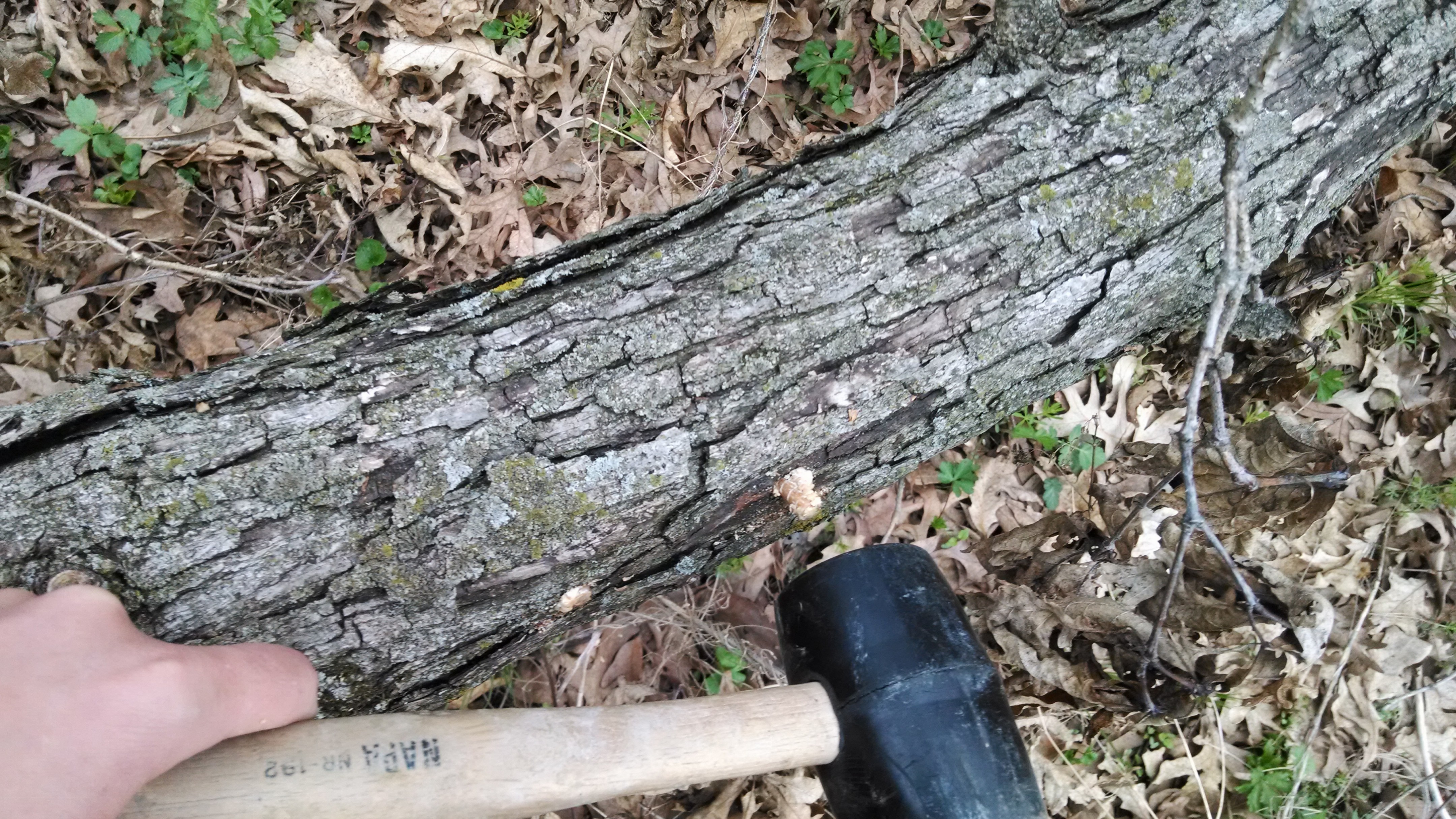
Tapping the plug snugly into the tree.
I’ll be sharing pictures as the mushrooms grow! Have you ever grown your own mushrooms?
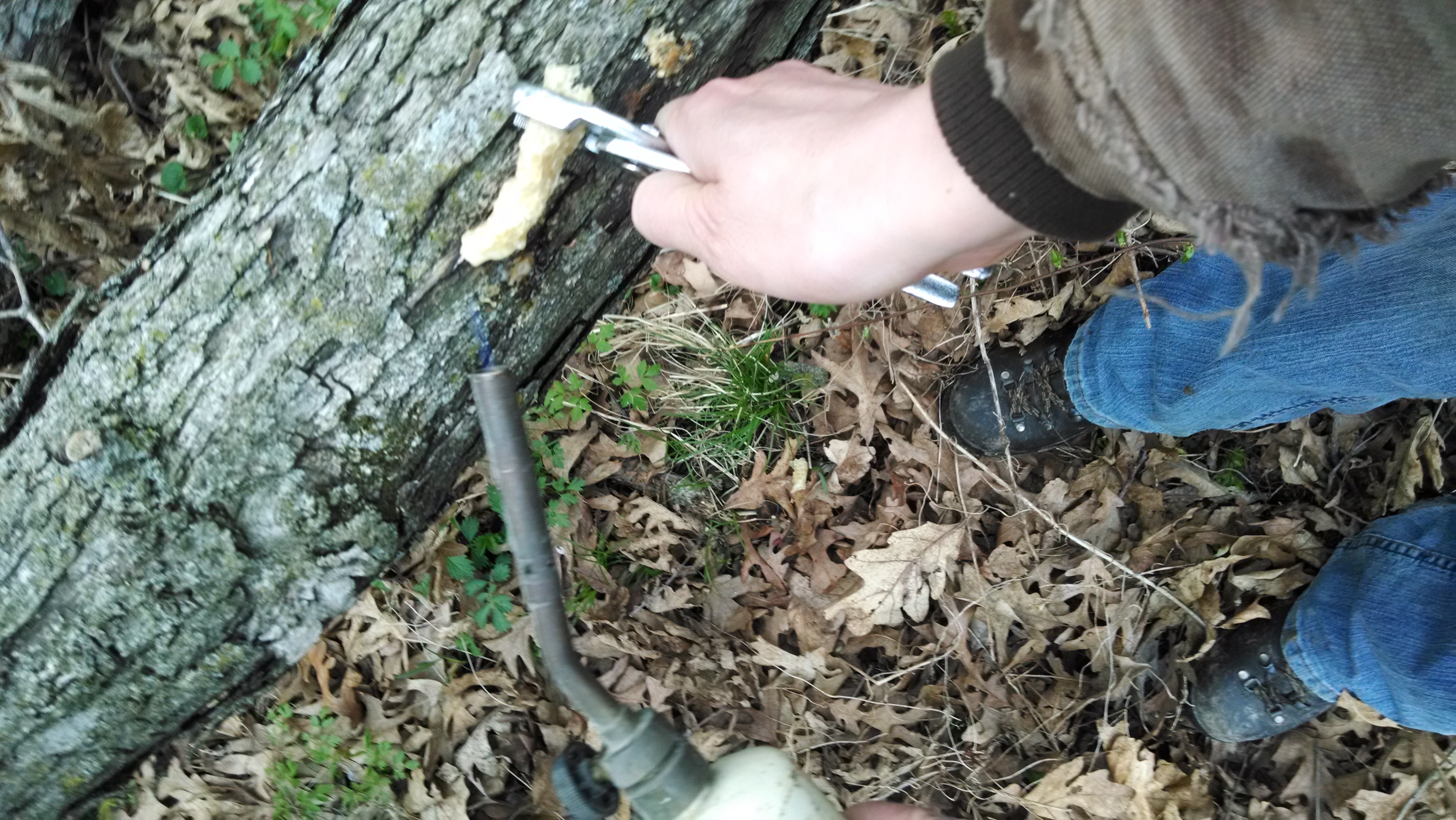
Sealing the plug into the tree with a bit of melted beeswax. There are definitely more efficient means of melting beeswax than a torch (the directions recommend melting the wax in a pot, and painting it on the plug). Now, we wait!
How are you celebrating Earth Day 2015? If enjoying all the abundance of the Earth – like the wildflowers and rainbows under the sun isn’t enough, you could get up before the sun rises to see a spectacular shooting star show! The Lyrid Meteor Shower 2015 will peak in the wee hours of April 23, 2015.
First some vocabulary:
A Shooting Star is bright streak of light caused by a meteor.
A Meteor Shower is the Earth passing through the wake of the comet and named for constellation nearest the point the meteors seem to radiate from.
A Comet is an icy-rock ball that orbits the sun and has tails of dust and gas streaming away from the sun
Meteoroid – relatively small particles in space
Meteor – a meteoroid that entered Earth’s atmosphere (shooting star)
Meteorite – a meteor that didn’t burn up before landing on earth
The Lyrid Meteor Shower seems to radiate from the constellation Lyra. Lyra is from the Greek word for lyre and is connected the myth of Orpheus, a musician who charmed all with his playing. The Classical myth ends sadly for Orpheus, but if you’d like to hear a folk version with a happy conclusion, I highly recommend the song “King Orfeo” written by Lisa Theriot and sung by Ken Theriot on the CD Human History.
But I digress!
Lyra Constellation Map (creative commons use)
The constellation Lyra contains the star commonly known as Vega — 5th brightest in the sky and part of the Summer Triangle. To learn more about Lyra check out Solar System Quick’s guide.
The comet wake or path that causes the Lyrid Meteor Shower is called Comet Thatcher and was seen in 1861 — and isn’t expected again until 2276, according to EarthSky. Add that to your smartphone’s calendar before you forget!
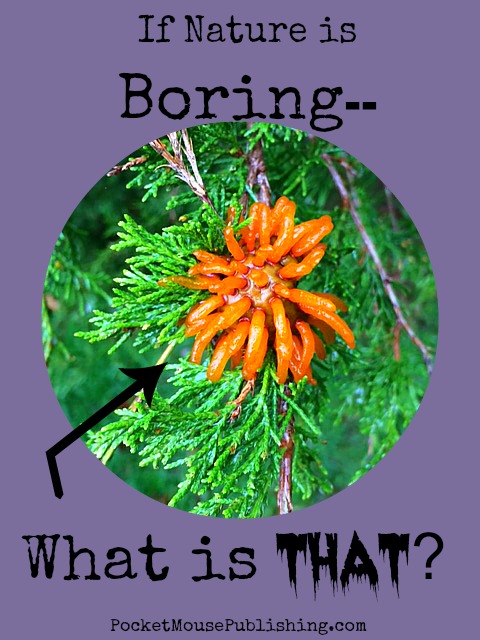
Do you think nature is boring? Do your kids? Just another walk in the woods? Same nameless green trees, same nameless green plants, same —
What would you do if you came across an orange tentacled blobin a cedar tree? And not just one? But another, and another, and one with even more tentacles?
a) Run screaming?
b) Call the police?
c) Email the county’s pest control department?
d) Pluck to one to dissect in the name of science?
e) Call…whoever would be interested in an alien sitings?
After coming home and finding some of these bizarre apparitions on the cedar trees in both my neighbor’s and my yard, I chose answer C.
And the calm, kind urban forester who replied to my email assured me that this was fairly common in my county and not of concern unless I had an orchard. Which now I’m glad I don’t have an orchard because this is Cedar Apple Rust (not an alien invasion).
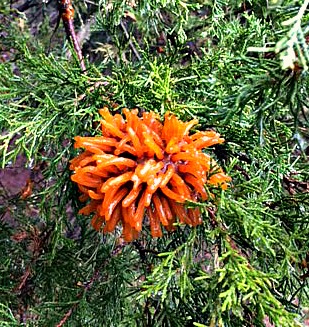
Doesn’t it look alien?
These are Gymnosporangium juniperi-virginianae galls with spore horns (not orange tentacled blobs): a complex pathogen that requires both the apple tree and the cedar tree (with other species such as hawthorn and juniper standing in), adequate moisture, including a rain, and has a two year life cycle. You can read all about these fascinating galls on Cornell University’s Integrated Pest Management Fact Sheet.
So, the next time you think just another boring nature walk, think again. And carry a camera — might just find something incredible for your Earth Day Celebration rainbow walk!
Thank you! We’ll nominate our own favorite blogs soon, but in the meantime, a bit about us in answer to the questions posed by Seedling — Lee in blue, Jean in red, and Gabe (the elusive illustrator of Hunting Red) in green!.
What is something that you appreciate today and why?
Lee: Eating outside on the front porch in the sunshine.
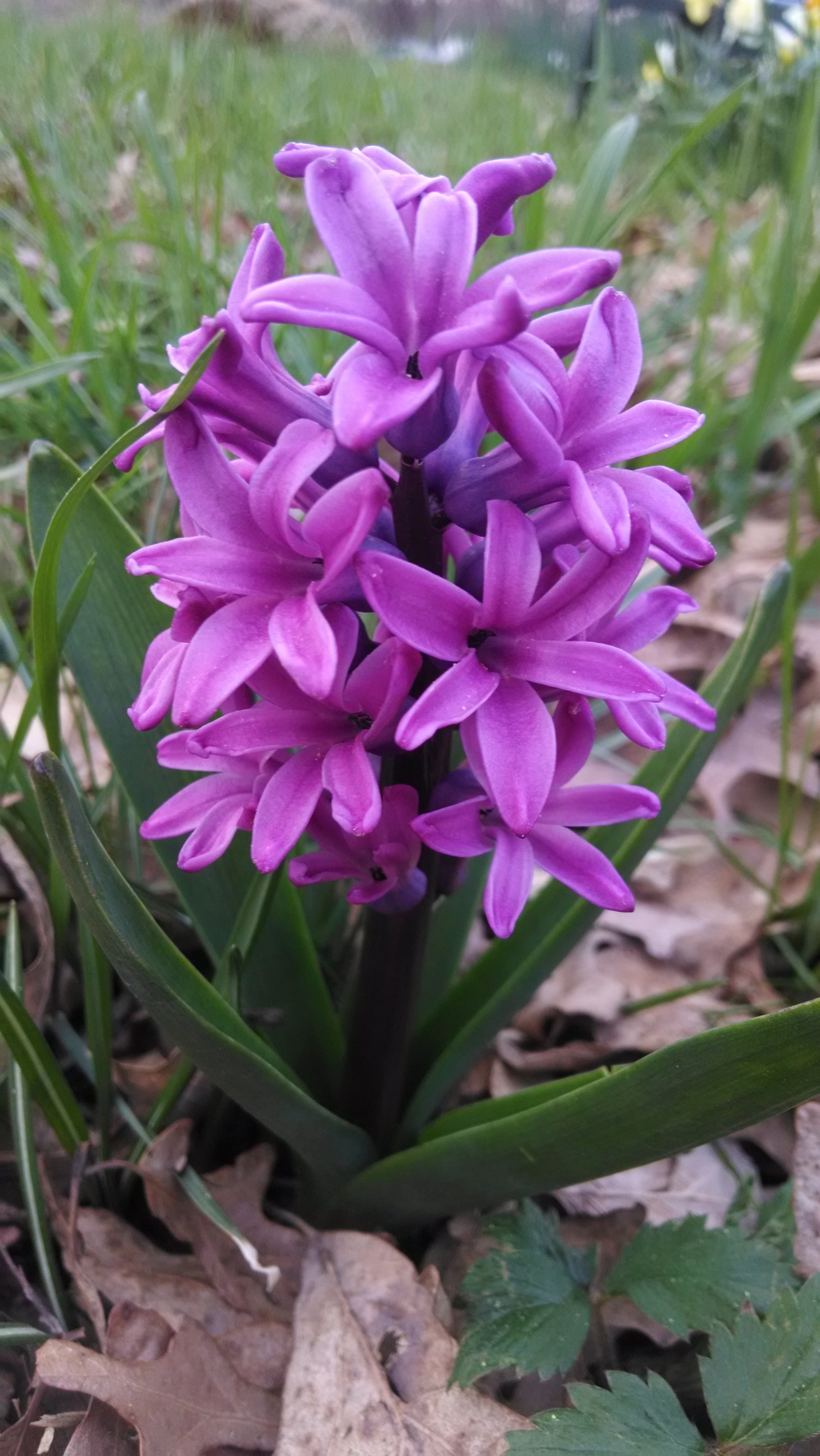
Jean: Everything. Life should be lived in appreciation. Specifically, there is a flower blooming in my yard that I don’t recognize.
Gabe: Today? I don’t have to go to work or class!
Do you recognize this flower?
What is something that you recently learned?
Lee: How to post to twitter — @pocketmousepub!
Jean: How to make charcoal. My knowledge heretofore has been theoretical.
What is something that you love about yourself and why?
Lee: My cursive handwriting. It’s legible, uniform, and well, lovely. Sadly, none of my children have inherited it.
Gabe: I taught myself to be ambidextrous (after reading The Queen of Attolia).
What is something that you had always wished to do and achieved?
Lee: I always wanted to homeschool. I heard about it while I was in high school, and now I have two who have graduated and four I’m still homeschooling.
Gabe: Complete the full 50,000 word NaNoWriMo this past November.
What is something that you still wish to do before you pass on?
Lee: Travel the world with my husband on a sailboat or catamaran.
Jean: I try to avoid bucket lists. If there is something I want to do or experience, I try to prioritize it for its own sake and create a plan for making it happen. If it doesn’t happen, it should either be because 1) I never got beyond the wishful thinking stage to fully develop it, or 2) I decided, consciously or not, that other priorities were more important.
How many languages do you speak?
Lee: Just English. I know a little Latin and a smattering of Ancient Greek from learning alongside my children. Not that those will help me while I’m sailing!
Jean: I’m fairly adept at English and appreciate etymology.
Gabe: Not Spanish or Latin (sorry, Mom). I’m creating my a language for world I made — check back in 5 years to see if I speak it yet.
Sketch from a World created by Gabe
If you made a New Year’s Resolution this year, are you still working towards it? If so, in what way?
Lee: Not a New Year’s Resolution but back in mid-February I made a commitment to get my children out into nature every day. We haven’t missed a day yet! Of course, not everyone goes every day. Getting 8 people around the dinner table at one time is hard enough, let alone out for an hour in the woods!
Gabe: I resolved to keep working on my 50,000 word NaNo novel. April is Camp NaNo, and I’m adding at least 30,000 words to scenes I skipped in November.
What is one way in which you live authentically?
Lee: My priorities are my own. Reading aloud to my children daily and only buying quality dark chocolate are high on my list. Dressing stylishly and dusting the house are very low.
Jean: I am developing a better understanding of the plants around me on a deeper level. Specifically, I’m focusing on their nutritional and medicinal value, and how valuing them can bring me into harmony.
What is one of your own ‘natural highs’?
Lee: Being near rushing water: from the babble of the creek running over the rocks, to the thunderous noise of the rapids on a big river — I love the sound.
Jean: Riding in the fields with Frank, my horse. Hiking in the woods with Nitro, my dog.
Gabe: Riding my bike downhill very fast. Hitting people with sticks — SCA heavy-combat style, of course.
What is your wish for the world and how do you work towards it?
Jean: Sharing the joy, learning, and wonder that come from being in nature. That passion was the basis for writing Hunting Red and why I’m the Land Stewardship Director at Indian Creek Nature Center.
Thanks for reading, and when we get those questions & nominations together, we’ll share!






 Pocket Mouse Publishing