Earthing at the Hydra’s Lair on the First Morning in May

Happy May Day!  Today, being the first day of May means we listen to “Lady Isabel and the Elf Knight” by Lisa Theriot.  The song has a rich and varied historical basis which you can read all about on Wikipedia.  Some day, maybe next April, I plan to research it myself!

Lady Isabel and the Elf Knight - a song for the first morning in May
Hunting Red’s artist sketched the opening scene

My children disagree with the term “Elf Knight” — they claim he is neither elf nor knight, but rather one of the Fey.  I’ll leave that research to them.

Also since it is May 1, we started our 30×30 Outdoor Challenge — with a 40 minute walk to the Hydra’s Lair.  This is a retention waterway at the base of a hill in a nearby neighborhood.  I have yet to see the hydra, but today there were 1000s of tadpoles wriggling in the shallows.

Checking out tadpoles on the first morning in May
No hydras, just tadpoles

By checking off our 30×30 Challenge, we are also on our way to completing the 30×3 Challenge!  After dinner we took a 20 minute walk as well.  So 60 minutes for Day 1!

Earthing!  Walking barefoot on the earth...
A little EARTHING in the last snow of the season

I learned a new word today.  Earthing.  Earthing is the process of absorbing earth’s free flowing electrons from it’s surface through the soles of one’s feet.  So that’s why my children are always barefoot!

May your May be filled with music, successfully completed challenges, and a little earthing!

~Lee

Challenges to Getting Outdoors Daily

Is getting out into nature daily a challenge?

Or do you need a challenge to get out daily into nature?

Getting out into Nature a challenge? {PocketMousePublishing.com}Tomorrow is May 1.  Nothing like a new month to take on a new challenge.  And MAYbe this is your month.  May is spring in the northern hemisphere and autumn in the southern hemisphere — not too hot, not too cold, just right for getting outside and getting a daily dose of nature time!

But…maybe you’re feeling too busy.  Or maybe you’ve had a nature walk go wrong.  Or maybe you can’t seem to remember a single benefit to time outdoors when the kids beg for just 30 more minutes in Minecraft. Or is that only at my house?

Getting outside, every day, can be a challenge — so here are 3 challenges to get you there:

1. Starting May 1, the David Suzuki Foundation has a 30×30 challenge.  That’s 30 minutes outdoors for 30 days.  Do you have 30 minutes?  Just 30 out of 1440 a day — about 2% of your time.

100 Trees, 100 Chances to Get Outside! Free Worksheet Download

2. Want something less time-bound? Wilder Child offers a chart called 100 Trees, 100 Chances in the fantastic article 6 Ways to Get Your Kids Outside (When They Don’t Want to Go).  Color a tree every time you go outdoors and watch your forest grow!

3. Is a purposeful, structured  time more your style?  Back in 2008, the Handbook of Nature Study Outdoor Hour Challenge began — and is still going.  Years of challenges to get you started and keep you outside!

Do you know of another challenge that encourages getting outside regularly? Share it in the comments! Or tweet to @pocketmousepub and let us know!

And after you’ve been outside, check out the Nature Chills Challenge to share what you’ve discovered!

I just read a 2010 study that found kids ages 8-18 spent 7 hours and 38 minutes in front of a screen daily, about 27% of their day.  Has technology use gone up or down at your house in the last 5 years?

Mushroom Trees

For National Arbor Day, I decided to plant some “mushroom trees.” I have healthy, mature oaks. I have young northern pecans, Kentucky coffeetrees, and Ohio buckeyes. I also have, typical of Iowa’s woodlands, forest areas so overgrown that trees need to be removed, not planted. And, while I continue to work on improving the diversity of the woodlands, planting a typical tree for National Arbor Day seemed counter-productive this year.
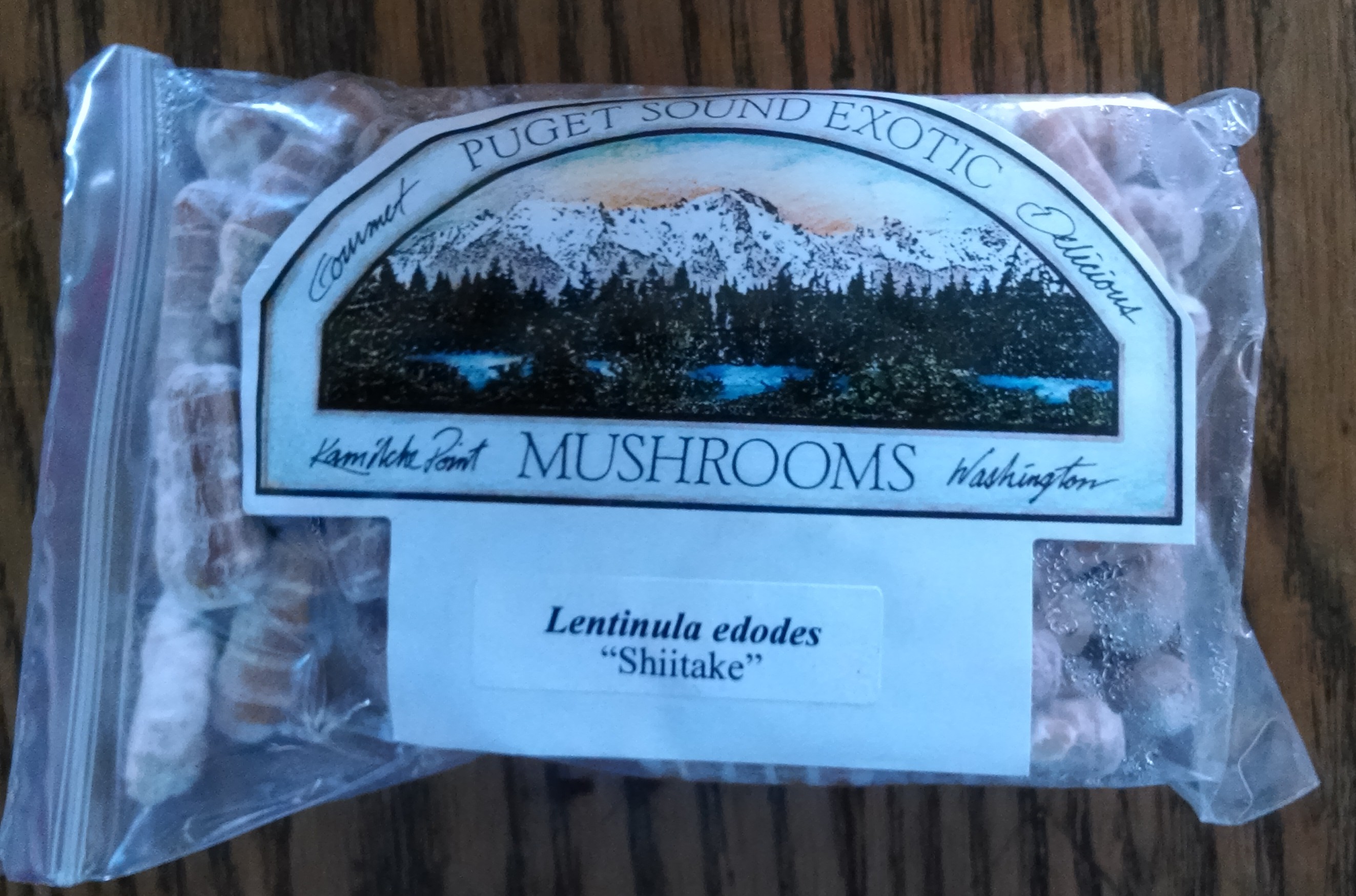
Shiitake “plug spawn”. Dowels inoculated with mycelium

Dying trees are critical for the health of a forest. They provide habitat for cavity nesting birds, screech owls, bluebirds, and wood ducks. They serve as roosts for bats and feeding stations for insect-eating birds. A dead snag hosts a tremendous variety of decomposers, from fungi to ants, which gradually break down the hard wood into soft, rich organic matter in which new life can grow.

Mycelium rapidly expanding around the dowel
I thought deliberately turning a dead log into a mushroom tree would be a fun way to celebrate the spirit of National Arbor Day, without adding a tree where it shouldn’t belong. It will celebrate that the value of a tree extends far beyond the life span of the tree. As a benefit, I will
1) expand my knowledge of mushrooms, and give me a close up, regular look at the decomposition process
2) provide me with something healthy and tasty to eat
3) provide organic material, when the tree is completely broken down.
IMG_20150424_072600281
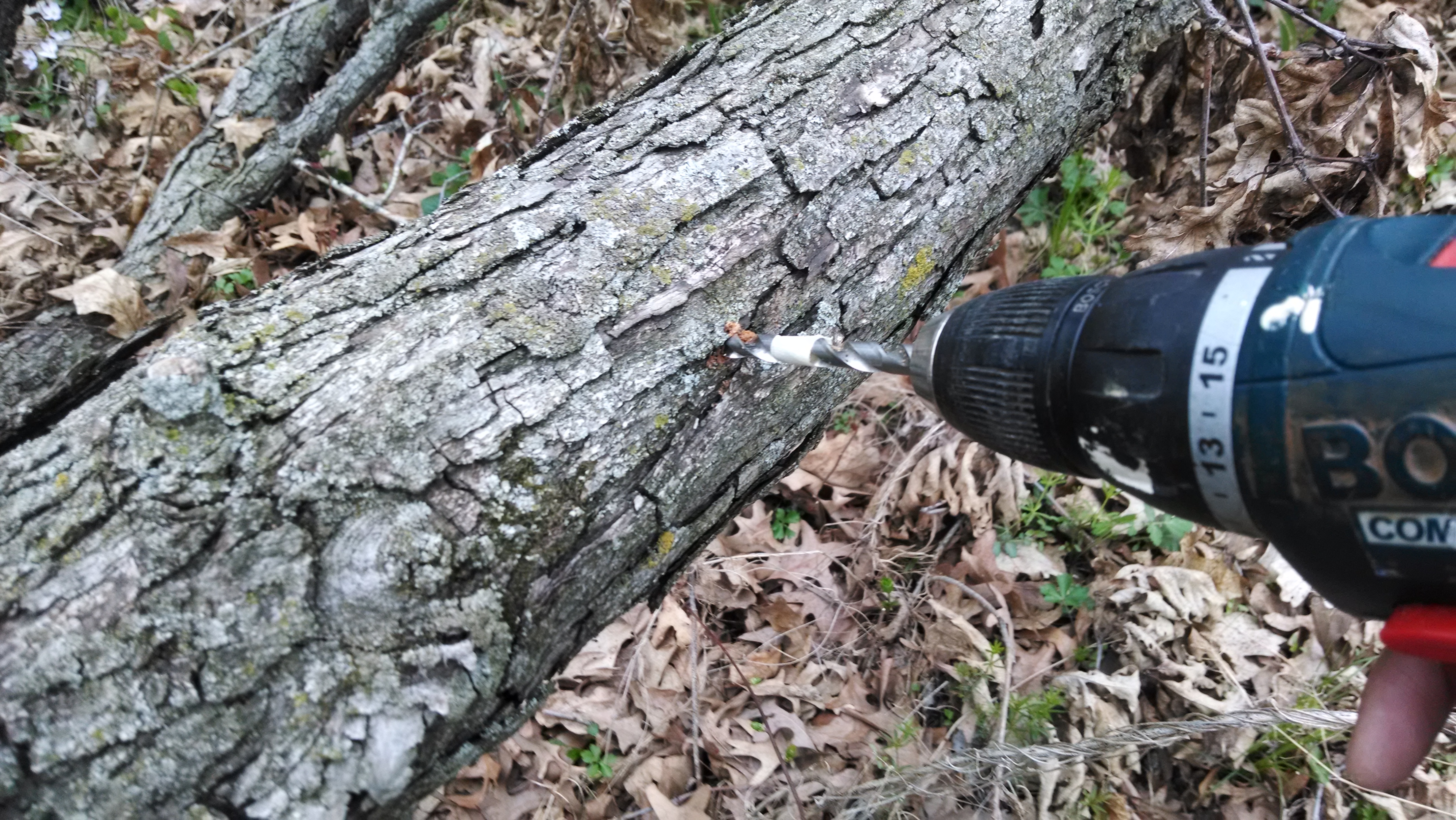
Drilling the holes in the oak limb, a casualty of a recent wind storm

In the past, I’ve grown portabella mushrooms in a box in the house, and thought this would not be too much more difficult. And then, when I got my shiitake, maitake, and reishi mushrooms from Fungi Perfecti…I realized that it may not be more difficult, but it is certainly a bit more specific and detailed.

IMG_20150424_073628008
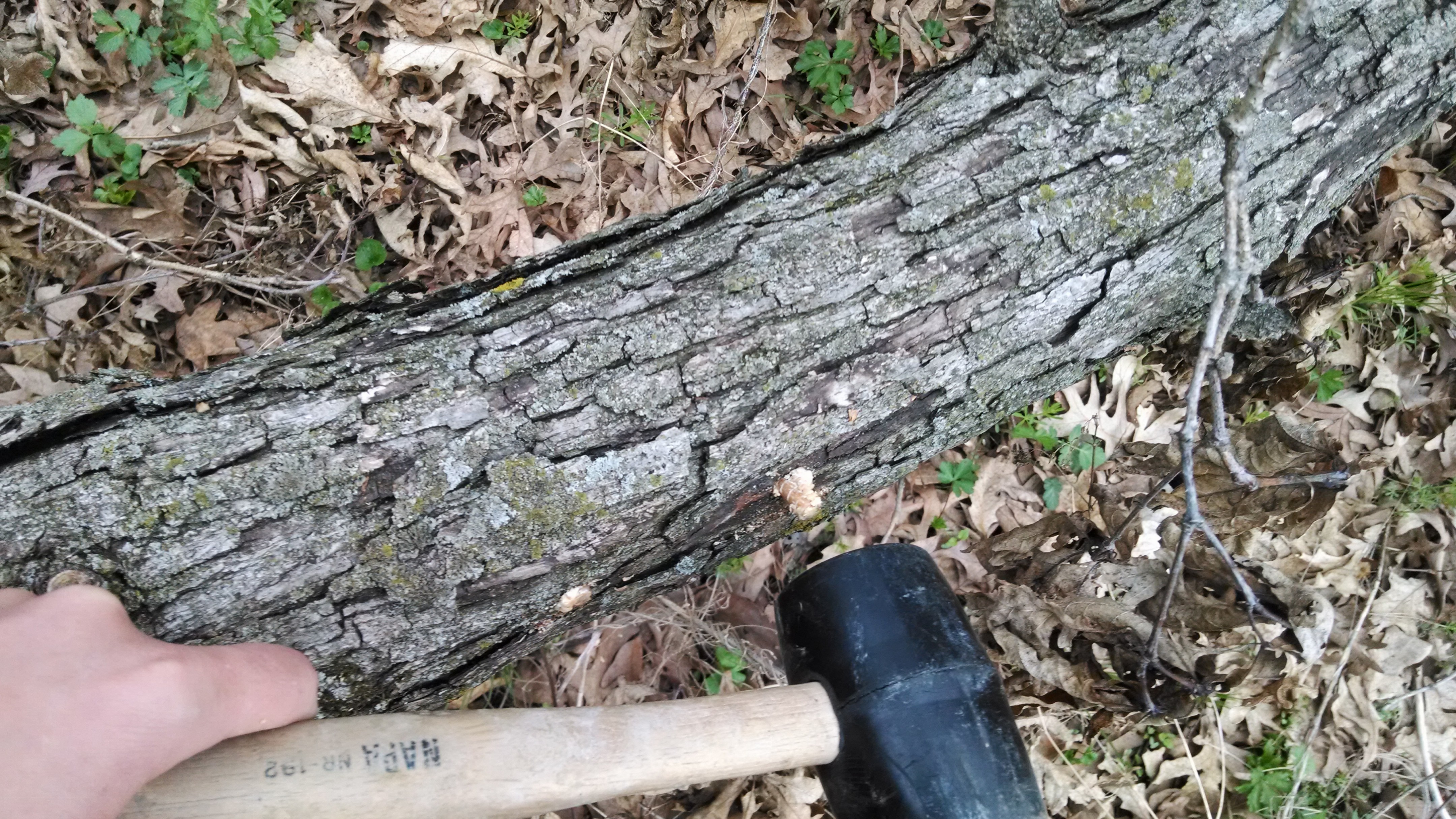
Tapping the plug snugly into the tree.

I’ll be sharing pictures as the mushrooms grow!  Have you ever grown your own mushrooms?

IMG_20150424_074145574
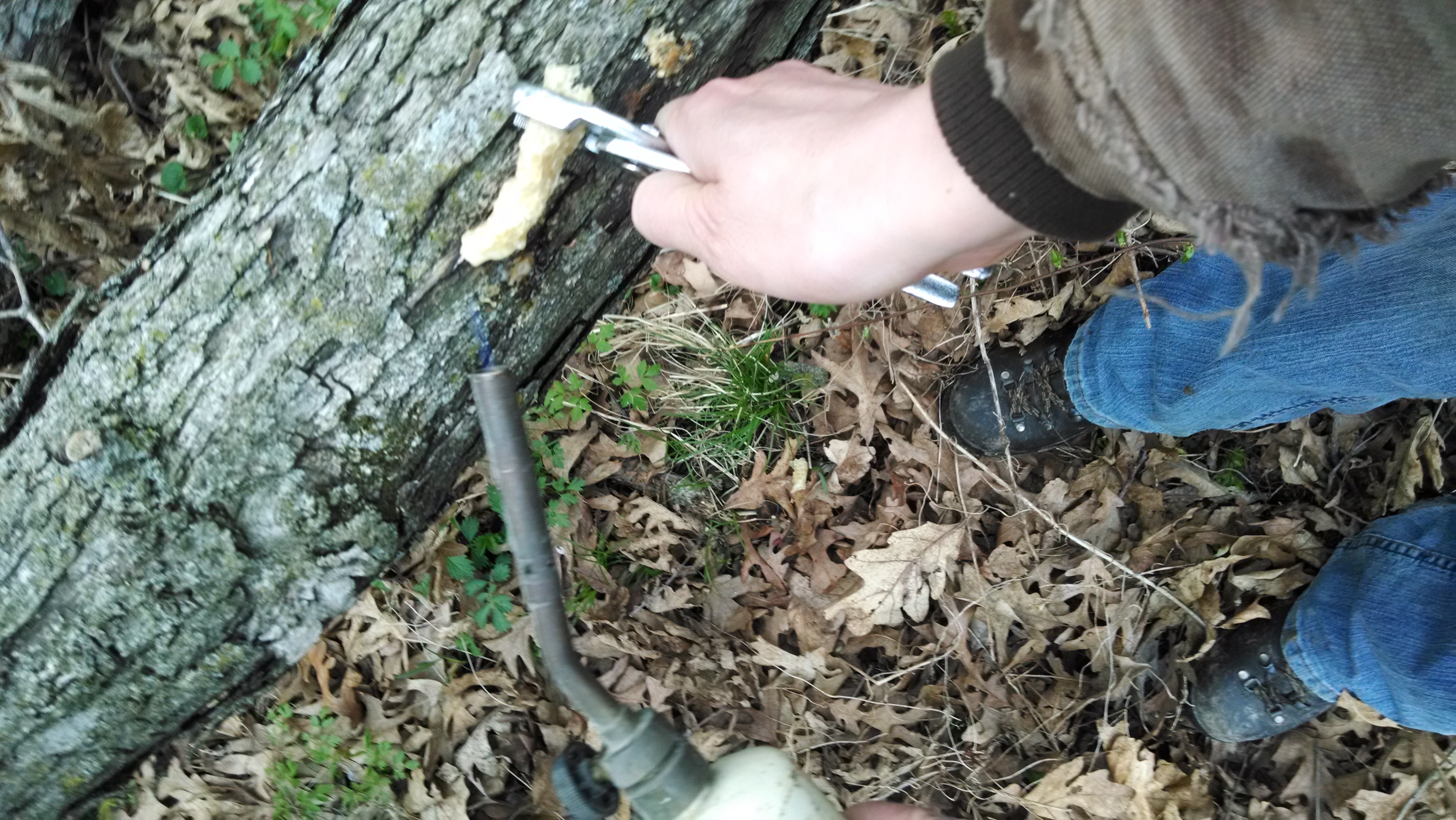
Sealing the plug into the tree with a bit of melted beeswax. There are definitely more efficient means of melting beeswax than a torch (the directions recommend melting the wax in a pot, and painting it on the plug). Now, we wait!

Think Nature is Boring?

Do you think nature is boring?  Do your kids?  Just another walk in the woods?  Same nameless green trees, same nameless green plants, same —

Another boring nature walk? I think not.

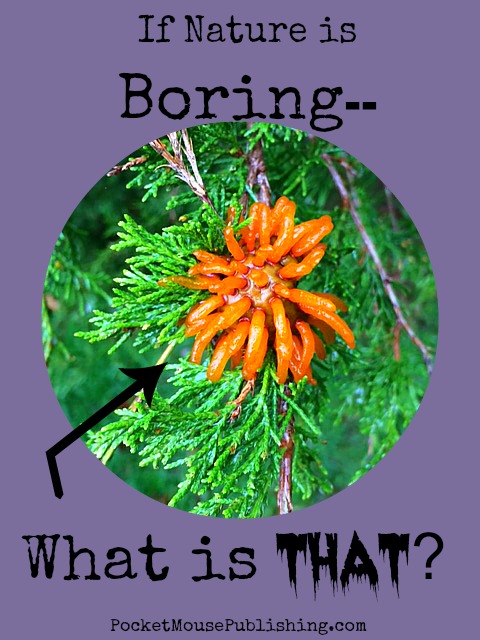
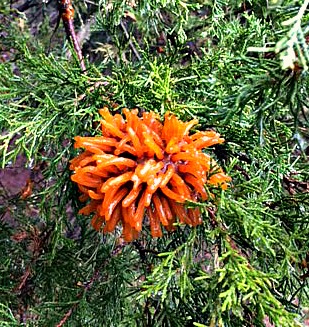
What would you do if you came across an orange tentacled blob in a cedar tree?  And not just one?  But another, and another, and one with even more tentacles?

a) Run screaming?

b) Call the police?

c) Email the county’s pest control department?

d) Pluck to one to dissect in the name of science?

e) Call…whoever would be interested in an alien sitings?

After coming home and finding some of these bizarre apparitions on the cedar trees in both my neighbor’s and my yard, I chose answer C.

And the calm, kind urban forester who replied to my email assured me that this was fairly common in my county and not of concern unless I had an orchard.  Which now I’m glad I don’t have an orchard because this is Cedar Apple Rust (not an alien invasion).

Doesn't it look alien?
Doesn’t it look alien?

These are Gymnosporangium juniperi-virginianae galls with spore horns (not orange tentacled blobs): a complex pathogen that requires both the apple tree and the cedar tree (with other species such as hawthorn and juniper standing in), adequate moisture, including a rain, and has a two year life cycle.  You can read all about these fascinating galls on Cornell University’s Integrated Pest Management Fact Sheet.

So, the next time you think just another boring nature walk, think again.  And carry a camera — might just find something incredible for your Earth Day Celebration rainbow walk!

Earth Day Adventures: rainbows and wildflowers

This is a magical season in the forest, as the spring ephemerals are just beginning to bloom. When we think of forest, our minds immediately go to the trees. Right now, with the trees in various stages of budding out, there is not a leaf to be seen. But there is a whole rainbow of color to be found.

Cottonwood tree inflorescence, brought down in a windstorm (Red).
OK, I havent seen any orange butterflies yet, but these fun chairs are sitting outside ICNCs Butterfly Hoop House, beckoning a visit. If you want to see flying orange, try setting out a half an orange on a tray feeder or deck railing to attract Baltimore Orioles.
OK, I haven’t seen any orange butterflies yet, but these fun chairs are sitting outside Indian Creek Nature Center’s Butterfly Hoop House, beckoning a visit. Or…
...set 1/2 an orange out on a tray feeder or deck railing to attract the Baltimore Oriole. This one, created by artist Brenna OHara, is a permanent resident along ICNCs woodland trail orange).
…set 1/2 an orange out on a tray feeder or deck railing to attract the Baltimore Oriole. This one, painted by artist Brenna O’Hara, is a permanent resident along ICNC’s woodland trail (Orange).

Lots of life is beginning to emerge from the ground.  Wildflowers of Iowa Woodlands by Sylvan Runkel and Alvin Bull is a great resource to put in your backpack before setting out. If that’s too big, try the laminated Woodland in Your Pocket pamphlet. Finding flowers is fun: knowing what you’re looking at is thrilling.

Bloodroots are one of the first spring ephemerals to explode in the spring (Yellow).

Delicate, small forbs take advantage of all of that sunlight streaming through the bare branches to send up their own leaves, flower, and reproduce.

Wild Ginger is just beginning to peek out, with soft folded leaves (Green). Open your copy of Hunting Red to preview the ginger in bloom.
A blue jay was here. As the feathers of most birds are protected, take pictures, not the feathers (Blue).

To help identify feathers you find, visit the U.S. Fish and Wildlife Service’s free online Feather Atlas.

These bluebells have not fully opened, but show some of the great diversity of color the species has Indigo)
These bluebell flowers have not fully opened, but show some of the great diversity of color within the species (Indigo).
The petals of the wild violet are edible, and are a beautiful edition to any salad Violet).
The petals of the wild violet are edible, and are a beautiful edition to any salad (Violet).

Spend Earth Day outside, exploring what is happening with the earth as spring surrounds us in a rainbow of color. What colors will you find?


Chirping on Twitter as @pocketmousepub!

Connect with Pocket Mouse Publishing on Twitter @pocketmousepubPocket Mouse Publishing is on Twitter!  Yes, you will hear Jean (itsabeeslifeforme) and Lee (brightskymom chirping tweeting as @pocketmousepub now!

Since we’re brand new, we will bumble around like the fledgling social media-ites that we are.  If you’re on Twitter, we’d appreciate well-known, obvious, how-could-you-not-know tips — I don’t think we’re ready for amazing insider secrets yet!

We hope to see & hear you in the fields and trees, tweeting interesting tidbits about #nature and #forage and #organic and all kinds of things!  After all (to quote Robert Louis Stevenson, April IS National Poetry Month!):

The world is so full of a number of things,
I ’m sure we should all be as happy as kings.

Earth Day Adventures: forage

IMG_20150318_162615210
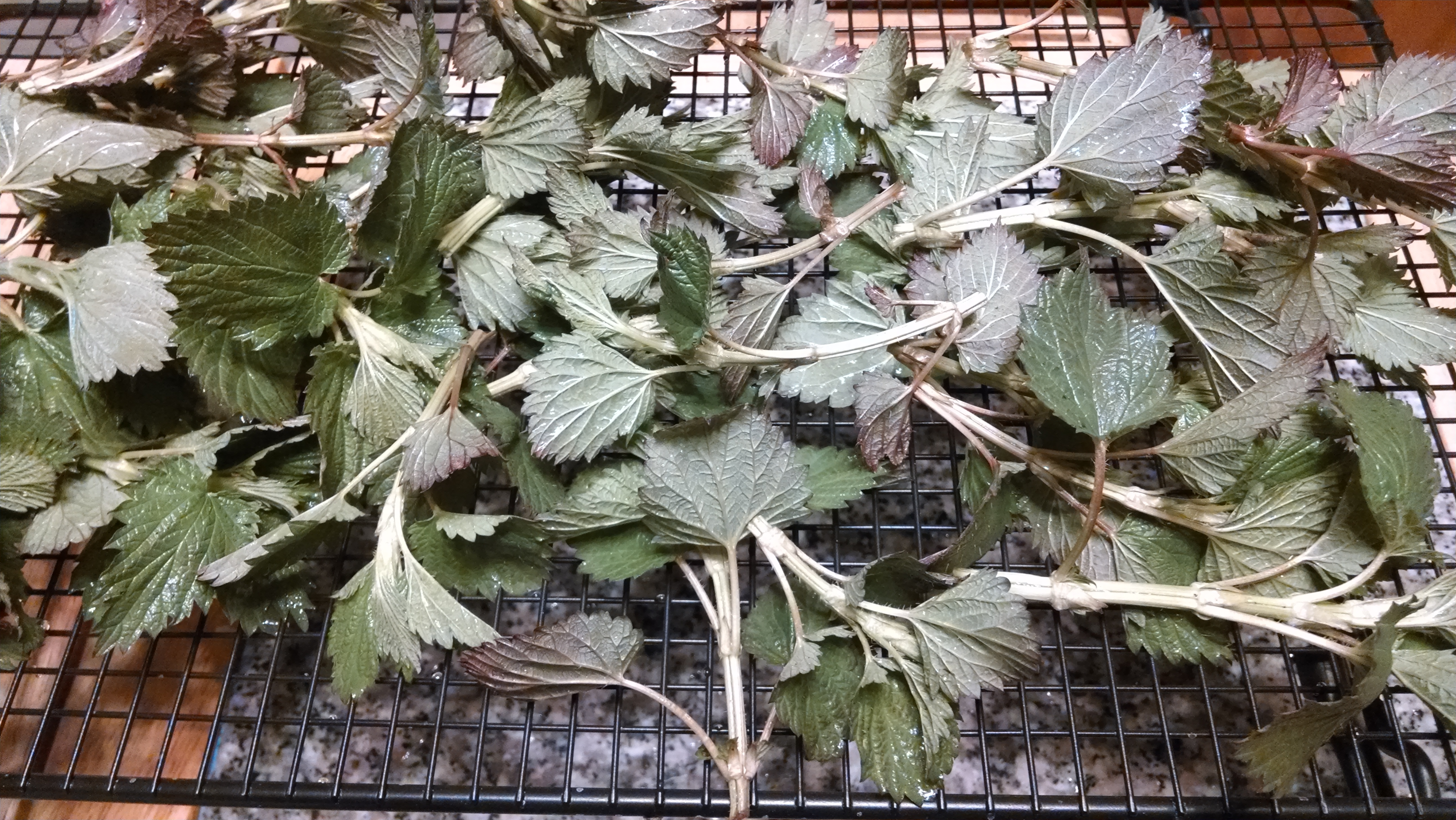
Pick nettles that are approximately 8″ tall, taking the top 6″.

By mid summer, moist woodlands are thick with stinging nettles. Long pants and long sleeve cotton t-shirts are a must, to keep waist-high plants from assaulting skin with trichomes. But right now, the stinging nettles are just beginning to emerge. Celebrate Earth Day by enjoying hunting for, gathering, and eating this delicious plant.


The leaves are tender and full of iron, vitamin A and vitamin C. The tiny hairs are just beginning to produce trichomes, so they aren’t nearly as painful if you break them off into your skin. Grasp the plant gently at the base and break the stem cleanly off. It won’t hurt the plant. If you can’t seem to get the knack of it without getting stung, wear a pair of gardening gloves or use a pair of clippers. As the nettles are a ubiquitous invader throughout the woods, stick a paper sack in your pocket to collect them in.

Once home, rinse them off and boil them for about five minutes. The boiling breaks down the toxins, making them safe to eat. Treat the leaves like spinach, adding a little bit of butter, salt, or lemon juice before serving. IMG_20150409_154827535


Dry the rest. The trichomes also break down as the plant dries. Add a teaspoon of dried nettle leaf to the teapot whenever you make a cup of tea, to take advantage of the nutrients in the plant long after the plants leaves are large and tough, and the trichomes are vigorous about defending it.

This book is older than I am, but the information in it is still a great foundation for foraging  for food in nature.
This book is older than I am, but the information in it is still a great foundation for foraging for food in nature.

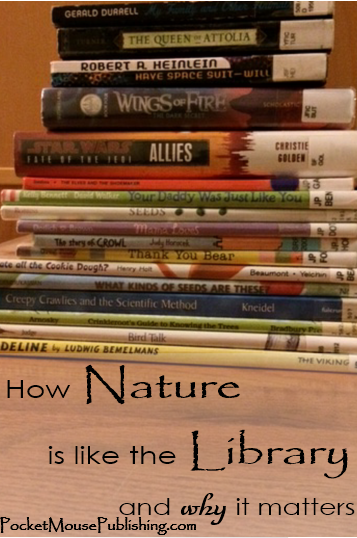
How Nature is like the Library and why it matters

How Nature is like the Library

Sitting in traffic on my way home from the library the other day, I got to thinking:

Nature – the great outdoors – is a lot like the public library.

Nature is space free for all to visit, all to peruse, all to enjoy – paid for by tax dollars, public & private benefactors, and citizen fundraising; maintained by forest rangers and naturalists (the librarians of their wild spaces) and the enthusiasm of volunteers.

We go to the library to learn: a vast collection of non-fiction books on every topic imaginable, waiting to be read and gleaned from. There is always something new to be found on a library shelf.  We can go to nature to learn as well.  Every walk in the woods will reveal something new.

Come forth into the light of things,
Let Nature be your teacher. ~William Wordsworth

Earth and sky, woods and fields, lakes and rivers, the mountain and the sea, are excellent schoolmasters, and teach some of us more than we can ever learn from books. ~John Lubbock

You will find something more in woods than in books. Trees and stones will teach you that which you can never learn from masters. ~St. Bernard
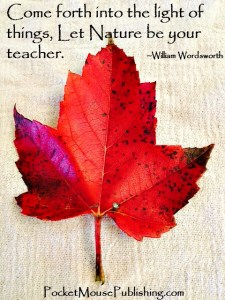
Let Nature be your teacher -PocketMousePublishing.com

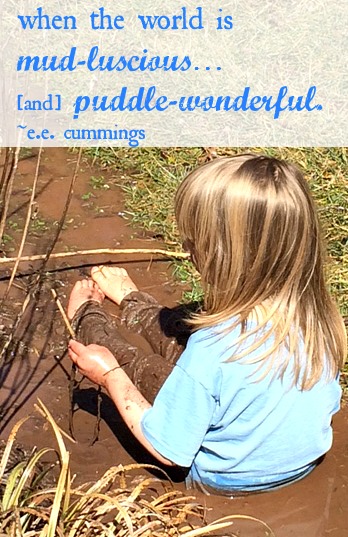
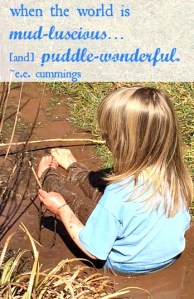
We go to the library for enjoyment: genre upon genre of fiction, poetry, picture books, movies, comics, how-to books. We can go out in nature for enjoyment too.  A mud-puddle and a mountain are always ready to provide a new experience.

when the world is mud-luscious…[and] puddle-wonderful. ~e.e. cummings

Forget not that the earth delights to feel your bare feet and the winds long to play with your hair. ~Khalil Gibran

Climb the mountains and get their good tidings. Nature’s peace will flow into you as sunshine flows into trees. The winds will blow their own freshness into you, and the storms their energy, while cares will drop off like autumn leaves. As age comes on, one source of enjoyment after another is closed, but Nature’s sources never fail. ~John Muir
How Nature is like the Library and why it matters

Just as our minds long for ideas that we can find in a book at the library, so our hearts and eyes long for nature – photos of breath-takingly beautiful nature scenes abound on Pinterest, are shared on Instagram, and hang on the walls of homes & offices around the world.

With innovation and technology, seems we have forgotten to cherish the true beauty the world has to offer. ~A.C. Van Cherub

Yet, unlike the library – still a place of generally hushed reverence (except during toddler story time!), nature is often carelessly used as a dumping ground – tires, empty cans, golf balls, and a large collection of half-filled plastic water bottles litter the creek near my home. Would you ever find these in your local library? Who keeps the library clean? Who keeps the natural spaces around your home clean?

If we all treated nature more like the library, I think the world would be a better place. We borrow. We return. We pay our fines when owed. We preserve. We respect. We enjoy!

May you find yourself out in nature or in a library today — better yet, both!

April 2015 Full Moon Walk & Lunar Eclipse

Full Moon Walk April 2015 Lunar Eclipse/Blood MoonAre you planning a Full Moon walk with your family this week?  This month’s Full Moon is on April 4, 2015 — traditionally called the Pink Moon, is also going to include the first total lunar eclipse of 2015!

A lunar eclipse occurs when the moon is in the Earth’s shadow. In some locations, the shadowing can cast a red glow on the moon, and so the moon can also be called a Blood Moon.

Solar and lunar eclipses always arrive in pairs — the lunar eclipse coming 2 weeks after the solar eclipse.  This and other interesting eclipse tidbits can be found at timeanddate.com — the website includes viewing information, video clips, and helpful explanations.

Full Moon Walk 2015 Printable from PocketMousePublishing.comDownload your free Full Moon Walk tracker  and enjoy this special time outside in nature!

Free Bird Printable Set of Hunting Red

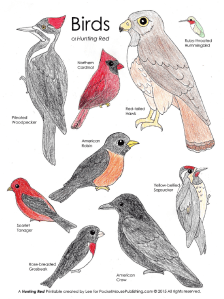
Birds of Hunting Red color page from PocketMousePublishing.com -- free download!
The free Bird Printable Set based on the nine North American birds found in Hunting Red* is ready for downloading! The set contains a full color page of all nine birds, an identical b&w page for coloring, a set of name cards, play ideas, and individual coloring worksheets for each of the following birds:

Red-Tailed Hawk
American Robin
American Crow
Yellow-bellied Sapsucker
Ruby-throated Hummingbird
Rose-breasted Grosbeak
Pileated Woodpecker
Northern Cardinal
Scarlet Tanager

Birds of Hunting Red hawk worksheet from PocketMousePublishing.com
Red-tailed Hawk worksheet

After creating the page featuring all nine birds together, I printed a copy for my 12yo son to color.  He used Hunting Red*, AllAboutBirds.org, and our beloved National Geographic Birds of North America* field guide to accurately color each male bird.  I chose to draw all males, although there is a mix of males and females in Hunting Red*.

He scanned the completed page, and printed it on cardstock to see how it looked.  Beautiful!  I laminated the colored bird page, along with the name cards, and cut them all out.  Then it was off to the park to play Bird Search — which is exactly like hunting for Easter eggs, but the fun is year-round!

The children stayed on the playground while I went to a little stand of trees nearby.  I hid some birds in the branches of the evergreens, some on the ground under those branches, and some I stuck into the bark of a deciduous tree.

Rose-breasted Grosbeak Worksheet from Hunting Red (PocketMousePublishing.com)
Rose-breasted Grosbeak worksheet

I laid out the name cards on the ground so the children could place each bird with its name as they found them. For my 5yo, I added the encouragement of “hot and cold”: “You’re getting warmer, warmer…oh, colder now, warm, burning! You found it!”

After all the birds had been found, we played 2 more times – once with my boys hiding them for their little sister, and once I helped her hide them for her big brothers.  Each time we moved to a new location in the park.

I hope you enjoy the printable set!  It was fun to create and plan to make additional sets based on the other flora and fauna of Hunting Red*. In the meantime, before you hunt for eggs — hunt for birds!

Pileated Woodpeck worksheet from Hunting Red (PocketMousePublishing.com)
Pileated Woodpecker Worksheet

You can download the free set by clicking here, and share this post with those who enjoy it!  Also, a special thanks to Deborah Leigh for use of her snail picture on the Scarlet Tanager worksheet!

As always, books marked with an * are affiliate links, and you can read our full disclosure at the bottom of the About page!