The Trouble with Trigger

Trigger is-as you can see-not a bird. The flock is a mixture of guineas, ISA Brown Roosters, and Black Star Roosters. They all agree on one thing: an opossum is not a bird, and does not belong in the aviary. Or so I thought earlier this fall, as they threw very vocal temper tantrums whenever Trigger wandered inside and they refused to go in for the night. Refusing to go in at dusk has resulted in the death of many a bird.
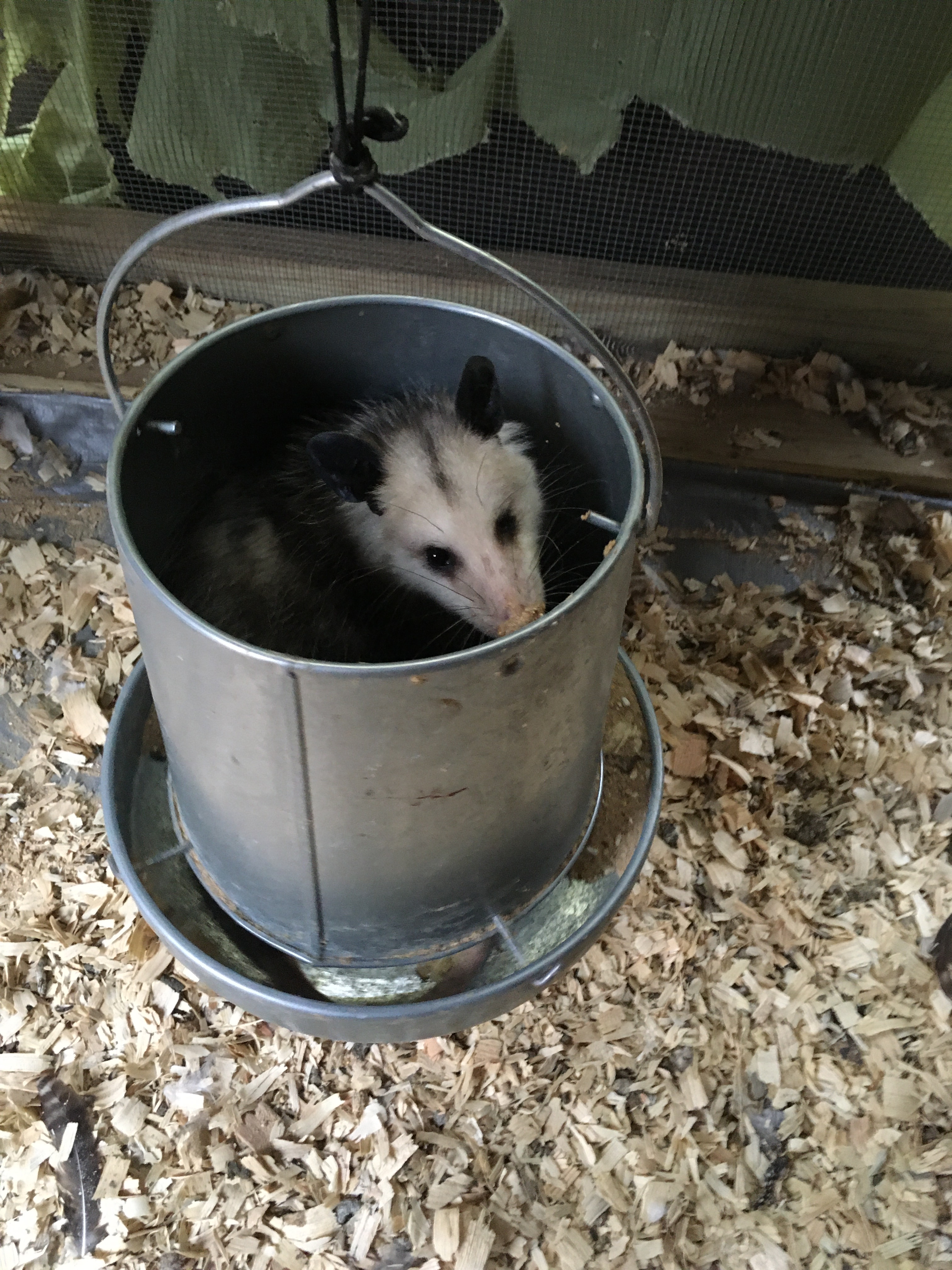
Trigger has emptied the chicken feeder of feed.

Trigger would let me carry him back out. He didn’t even fear me enough to bother playing dead. His tail was rubbery, his fur silky. As much as I love opossums, I thought, I can’t feed everyone. I feed the flock, I put tasty scraps out for everyone, and have a bird feeding station and a ground feeding station. I already am feeding everyone, in limited, affordable quantities. But Trigger eats a lot of food and upsets the flock.

Last night, I went out to button up the chickens. It was cold (it is 12 F now) and there is a foot of snow on the ground. The flock hasn’t ventured outside. Trigger was inside the aviary with the birds. I don’t know that anyone was happy about it, but those roosters are roosters. If they wanted to kick a young opossum out, they could. I sighed. Trigger moseyed out into the snow and headed for the woods, instead of waiting for me to take him into the shed for shelter. Nitro makes him nervous. I know this because he plays dead for Nitro. The tip of his tail was already suffering from frostbite.

This morning, I fed and watered the birds. Then…I took a bowl of cat food out to the shed for Trigger and the two other opossums who live there. One of the opossums is Kip, Trigger’s mother; the other is a skittish black opossum who hasn’t shared his name with me yet. Because it is higher in protein than bird seed, the cat food will support the opossums better through these cold nights.

To age a tree

It is impolite to ask a lady her age. It is impossible to ask a tree her age. But as these old, ancient ladies with their lacy leaves have finally fallen, I have been able to ask some of them. In death, they can share with me what they could not share in life.

The 9″ diameter Ohio buckeye: 32 years old

The 28″ diameter honey locust: 56 years old

The 24″ diameter white oak: 124 years old

The 36″ diameter cottonwood: 47 years old

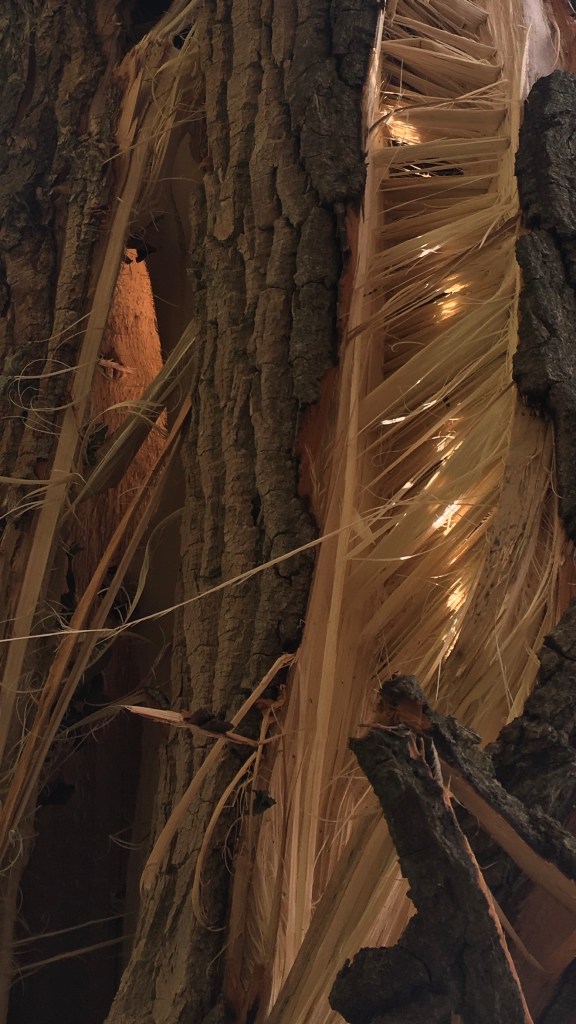
Ancient oak shattered.

The soil conditions, available sunlight, precipitation, and even genetics contribute to how big a tree gets. Some species simply get bigger faster than others. It is not a good thing or a bad thing. It makes it a very challenging thing, when people ask me how old a living tree is. An oak is probably older than you think. A cottonwood is probably younger than you think. Many of the massive trees brought down in the derecho were hollow inside, so we will never know. The massive sycamores and black walnuts growing along Indian Creek predate when the area was logged. So old.

Check out these imprints of an oak, walnut, and maple that were brought down by the derecho.

Since August 10th, I have sawn on trees that I planted. I have sawn on trees that I loved for more than 20 years. I have sawn on trees that were growing before women had the right to vote. I have sawn on trees that were growing before Iowa was a state.

I have touched trees that are still in the agony of dying, and I did not have the strength to give them a quick and merciful death by chainsaw. I have cried over and over again.

Trees are strong. Some of the trees I plant today will still be strong 100 years hence. Some I will cut down. Some others will cut down. Some will fall under the pressure from the termites, the buck rubs, the lightening and the wind. Some will remain. The massive old trees we grieve for today were young, once. Someone loved them and gave them space to grow. Nurturing our young trees and creating protected spaces for them to grow is the best thing we can do to honor the trees that have fallen and pay homage to the forest we love.

Young maple seedling.

To Start a Fire

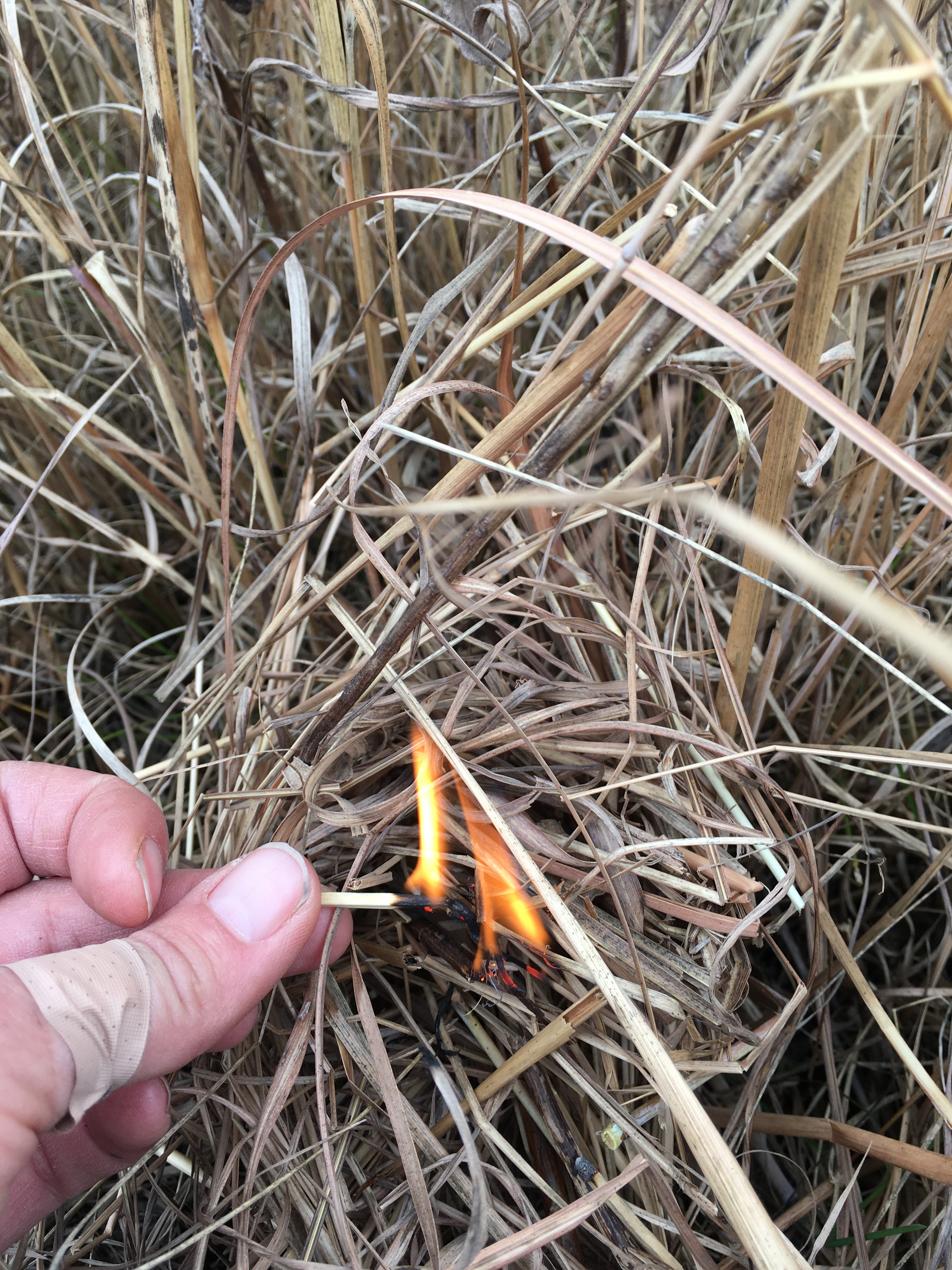
We had a beautiful, restorative fire on the Bena Prairie Friday. It started, like many fires, with a simple strike of a match. To start a prairie fire, I like to make a small ball of dry material, similar to a mouse nest, and place it at the base of standing prairie grasses, such as big bluestem.

From the match strike, the grasses of the tallgrass prairie, the topography of the land, and the wind should combine to create a prairie fire. We coax it along with our rakes and suppress it with our water tanks, but the fire itself is a living force on the land, bringing dynamic change. In the long term, it will be a positive change on the landscape. Locally, it will look stark until spring. When spring comes, the burned areas will green up sooner than unburned areas. There will be more flowers, and the vegetation will be taller than in areas that didn’t burn. Many of the young seedling trees trying to become established will die in the fire, enabling the prairie to remain a prairie for years to come.

The Sounds After The Storm (Sept 1)

I am done for the evening. Done with the sound of chainsaws, the sound of dying trees, the sound of dump trucks. Done with the smell of wood chips, the smell of two stroke engines, the smell of burning green wood.

Done with the sight of blue sky instead of green canopy, the sight of brush piled higher than me stretching for miles, the sight of shattered wood a solid mass across what was the forest floor.

Tomorrow is another day. But tonight, as the darkness brings a temporary peace, and the cicadas and owls replace the sounds of living inside a sawmill, tonight I am done.

A forest starts and ends with a tree

On August 10, I sent a text shortly after noon to my flatmates:

“Get the chickens in! Shriekies first, as the big ones can get under cover.”

I do not use exclamation points lightly. As things turned out, it was appropriate. I was experiencing the beginnings of a storm so severe it would sever my electronic communication for some time. That was the last dependable text I would be able to send or recieve for days.

The shriekies spent the storm safe inside in the bathroom, the older chickens safe inside in the garage. The forest that I have loved and cared for since 1996 didn’t fare so well.

The rain swept through, being driven by winds at 140 miles an hour for 45 minutes. Straight line winds of such magnitude are known as a derecho, I would come to learn. It destroyed homes (not mine), businesses (not mine), and trees. Many, many trees.

The community estimates that more than 60 precent of the tree canopy is gone. In looking at the broken tops and splintered trunks of the remaining trees, we will lose a lot more in the coming years from this singular event.

The shriekies, also known as keets or baby guinea fowl
Sunlight glows inside of a shattered but still standing tree.

What Goes into a Food Forest Canopy

One concern I have with the phrase “food forest” is that it implies that the rest of the forest is inedible. Nothing could be further from the truth, at least in Iowa. Upland forest canopies are dominated by oaks and hickories,  with a handful of butternuts mixed in. The midlands are full of mulberries, black cherries and black walnuts. Even the bottomlands, with their thick stands of silver maples and lindens, are full of edible life.

Linden blossoms are delicious in tea, and provide a valuable food source for pollinators.

In most landscapes, I focus on the natural history of the land, and ask what would be here, if we hadn’t cut the trees, grubbed out the roots, and planted corn in the heart of the forest? What is missing from both this particular plot, as well as the surrounding areas? What would increase the native diversity and resilience of the ecosystem?

In a food forest, I narrow that focus to species that 1) are native to the area, and 2) are fairly straightforward for humans to eat. A food forest has a greater concentration of native edible species than you might naturally find in a woodland. Done properly, a guest wouldn’t necessarily notice they were in a food forest; they would simply notice that they were in a beautiful woodland with abundant opportunities for them to forage as they walked. People are so far removed from what is and is not edible without a plastic wrap label and a price tag on it, I’ll probably need to put out signs. There isn’t much point, if people don’t know that the food in the forest is there for them.

A box elder tree comes down to make room for a new black maple tree. We have far more box elder trees on the land than we do black maples, so this will help create balanced diversity over time.

The pocket of sunlight we created this winter will be planted to maples this spring. I am locally sourcing Black Maple from Fleming Nursery and Sugar Maple from Hughes Nursery. Just downhill from the clearing is a large silver maple, well-suited to flooding. Mulberry and black cherry are already growing in the area, and we planted butternuts last year.

What Comes out of a Community Supported Forest?

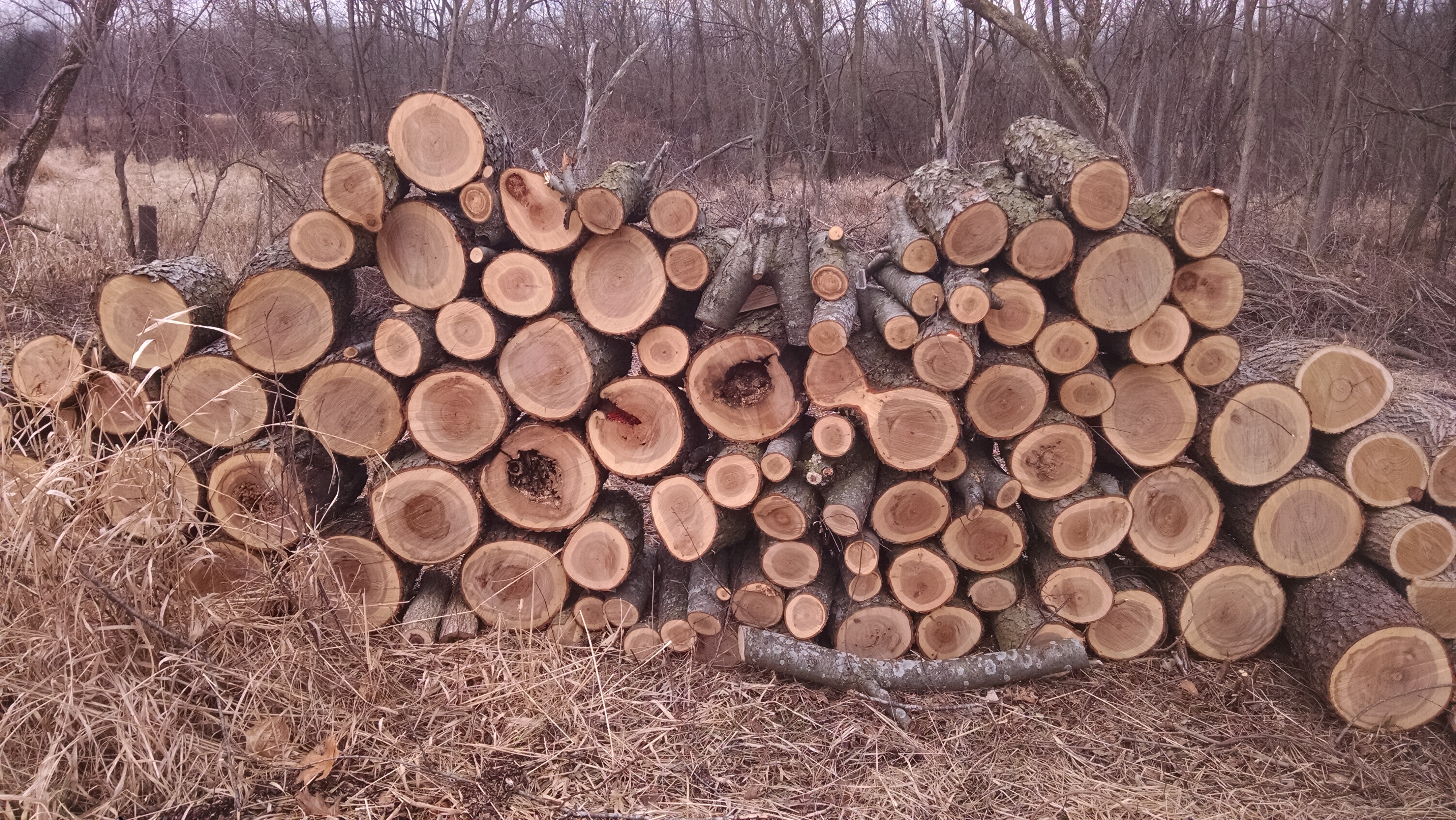
Firewood.

IMG_20180124_112025464

We took out two leaning black cherries. A third cherry was left, because black cherries, while tiny, are quite tasty. Spit the pits out! Cherry pits contain amygdalin.

We took out a half dozen small scruffy elm trees and mulberry trees. Two large red mulberry trees were left to anchor the southern edge of the forest, because mulberries are also quite tasty.

We took out a box elder, nearing the end of its life. All of the trees we cut were about 40 years old, and one was quite hollow in the middle. Check out the mouse cache of bittersweet berries.

IMG_20180124_112046272_HDR

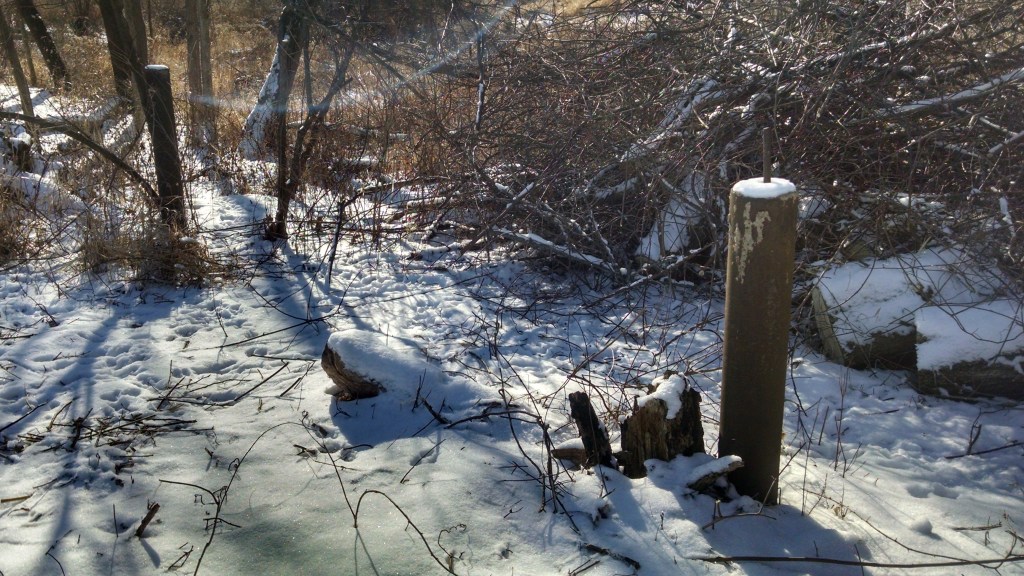
We also removed a variety of impenetrable bittersweet vines, green briar vines, honeysuckle bushes, and blackberry canes. The blackberry canes will come back with a vengeance (as will, regrettably, the others), but we needed a clear space to work in. Underneath that mess, we discovered the old fenceline.IMG_20180117_132737167_HDR

The firewood will be split, allowed to dry for two years, and then used to boil maple sap into maple syrup. It will also be used to heat the pizza oven.

Small Steps to Zero Waste

Packaging after-dinner leftovers can be something of a challenge in our house.

Jerry: I’ll clean up.

Jean: Awesome.

Moments pass. Then a wad of plastic wrap goes sailing into the living room.

Jerry: Maybe if you could just do something with the leftovers…

Jean: Of course.

Moments pass. A second wad of plastic wrap (this one launched by me) goes sailing into the living room.

Jerry: Maybe it will fit into a little container?

Plastic wrap has long been the bane of our kitchen. The metal teeth on the box will cut part of it, but not all of it. If the wrap is within 2″ of the box, it sticks to itself as if it were in a strange gravitational field. But getting the plastic wrap to stick nicely on anything once it’s out of the box is a disaster.

Jean: What did people used to do?

Jerry: They starved a lot. So when there was food, they ate it all.

This is clearly not a problem today (as my belly will attest to). But in a slightly less-distant past, back in the “good old days” when plastic wrap actually worked the way it was intended, it was made from polyvinylidene chloride. In 2004 it became in vogue to use low-density polyethylene (since vinyl and chloride are both chemicals that create a lot of problems, this was probably a really smart move). The new version may have made manufacturing cheaper and eliminated concerns about chloride, but it also doesn’t work. Except as interesting, non-harmful indoor projectiles when wadded up. All filmy plastics, including our wads of plastic wrap and sandwich bags, can be recycled with the plastic bag recycling. Which is good, but it is ridiculous for me to buy something just for the sake of recycling it.

Since I’ve been fortunate enough to never be close to starvation, I needed a better solution, and found it in beeswrap. Its natural, reusable, and wait for it…really works. I’ve been using it for three months now and only wish I had given up on plastic wrap years ago.


What goes into a Community Supported Forest?

My friend Shannon just left a sack of bladdernut (Staphylea trifolia) seeds on my desk. I know it was her, because how many of my friends know what a bladdernut is, much less that nothing would make me happier? A few years ago, Jerry brought home a pappery husk and asked me what it was. It took me a while to identify, because not only were they lacking from our forest, but as a diminutive understory tree, the bladdernut doesn’t make it in to many of the tree guides. The bladdernut is a delightful understory tree with an edible, if small, nut. We’ve only seen the single grove, a small layer in a larger grove of oaks, in the one location. I couldn’t find any one who sells them to plant at Amazing Space.

Next year, this important little cog will be replanted in the ecosystem, replacing a stand of invasive honeysuckles that currently do nothing more than provide a home for a feral cat and a handful of cowbirds.

in 2017 we planted paw paws (Asimina triloba) from Red Fern Farm. Another species once native, now vanished, will yield a mango-tasting, native fruit in coming years. It was likely originally native a bit south of here, but global warming is with us to stay. Ticks are now still active in February.

There are a handful of butternut (Juglans cinerea) trees on the property, but all are heavily cankered. Another friend, Roger, stratified a handful of nuts we collected in 2016, and started them in the spring. If I can keep the seedlings mulched, watered, and weeded, I can worry less about the species dying out here. And nothing is tastier than a butternut pie.

In years gone by, it took a community to manage and harvest the bounty from the forest. Today, it still takes a community to do the same. We just have better shovels (or on lucky days, PTO-driven augers) for planting seedlings and chainsaws for faster tree cutting. This should leave us plenty of time to enjoy a cup of tea by the fire with friends.

Jonquils and Iris

I was staring out the kitchen window, looking at the jonquil patch beside the garden, and realized the jonquils, about to burst into flower, really need to be divided to continue thriving.

Not that this is the best time of year to be dividing things, but I decided they would like nice in the orchard, which just last year was a mess of multiflora rose, garlic mustard, and honeysuckle. The apple trees are still so small, it looks a bit stark. Nitro and I went down to the orchard, and decided that yes, the jonquils would look lovely, but I should rally plant some iris first as a backdrop, as the iris grow taller. My inspection also revealed that the deer have finally discovered the tasty apple buds. On a mature tree the deer are not a problem. But if there are only a dozen buds on the tree in the first place, the deer can eat the whole thing. Apples will stump-sprout, but as they are all grafts…the fruit will not be tasty.

My work cut out for me, I went out to a field by a former farmstead, where the feral iris are thriving in a myriad of colors amidst the brome grass and occasional big bluestem, and dug two up two five-gallon buckets of rhizomes. Once they were all cleaned up they yielded 70 plants.

Rhizomes, separated and ready for planting.

Into the ground they went, and then, just as the rain was starting, I fenced the trees. Definitely not good enough to be a permanent deer barrier-I supplemented my metal fencing with previously cut thorny debris, including multiflora rose and black locust branches. But it will save the trees for a little while longer. Here we are, two weeks later, and I realized the jonquils…still haven’t been divided. A project that will just have to wait until fall, which they will prefer anyway.